

Benchmade and Spyderco dominate the knife market, yet they take fundamentally different paths. One prioritizes American manufacturing and proven reliability, while the other champions innovative design and global craftsmanship.
Choosing between them depends on what matters most to you: heritage and domestic production, or cutting-edge engineering and design diversity. This Benchmade versus Spyderco comparison breaks down steel quality, ergonomics, pricing, and real-world performance so you can confidently select your next blade.
Where Each Brand’s Philosophy Leads
Benchmade’s Domestic Manufacturing Commitment
Benchmade manufactures nearly all knives in Oregon City, USA, and this commitment to domestic production shapes everything the company builds. American-made knives command higher prices, typically starting around £100, because labor and materials cost more domestically. Benchmade accepts this constraint and uses it as a competitive advantage, marketing reliability and traceability to professionals who depend on their tools. The company collaborates with specialized designers like Mel Pardue, Warren Osborne, and Shane Sibert to create focused product lines: the Black Class for first responders, the Gold Class for collectors who seek limited-edition prestige pieces, and mid-range EDC models like the Bugout that balance performance with everyday practicality.
The Bugout: Benchmade’s Proven Standard
Field & Stream testing confirmed that the Bugout remains Benchmade’s best overall offering due to its 1.85 oz weight, 3.24-inch blade, and versatile design that works equally well for camping, hunting, or daily carry. Benchmade’s narrower catalog of 80+ knives means each model receives careful refinement; the brand prioritizes the Axis Lock mechanism for ambidextrous operation and emphasizes a thumb rest for opening rather than a hole in the blade. This design philosophy reflects a belief that reliability comes from proven engineering, not experimental variation.
Spyderco’s Expansive Design Philosophy
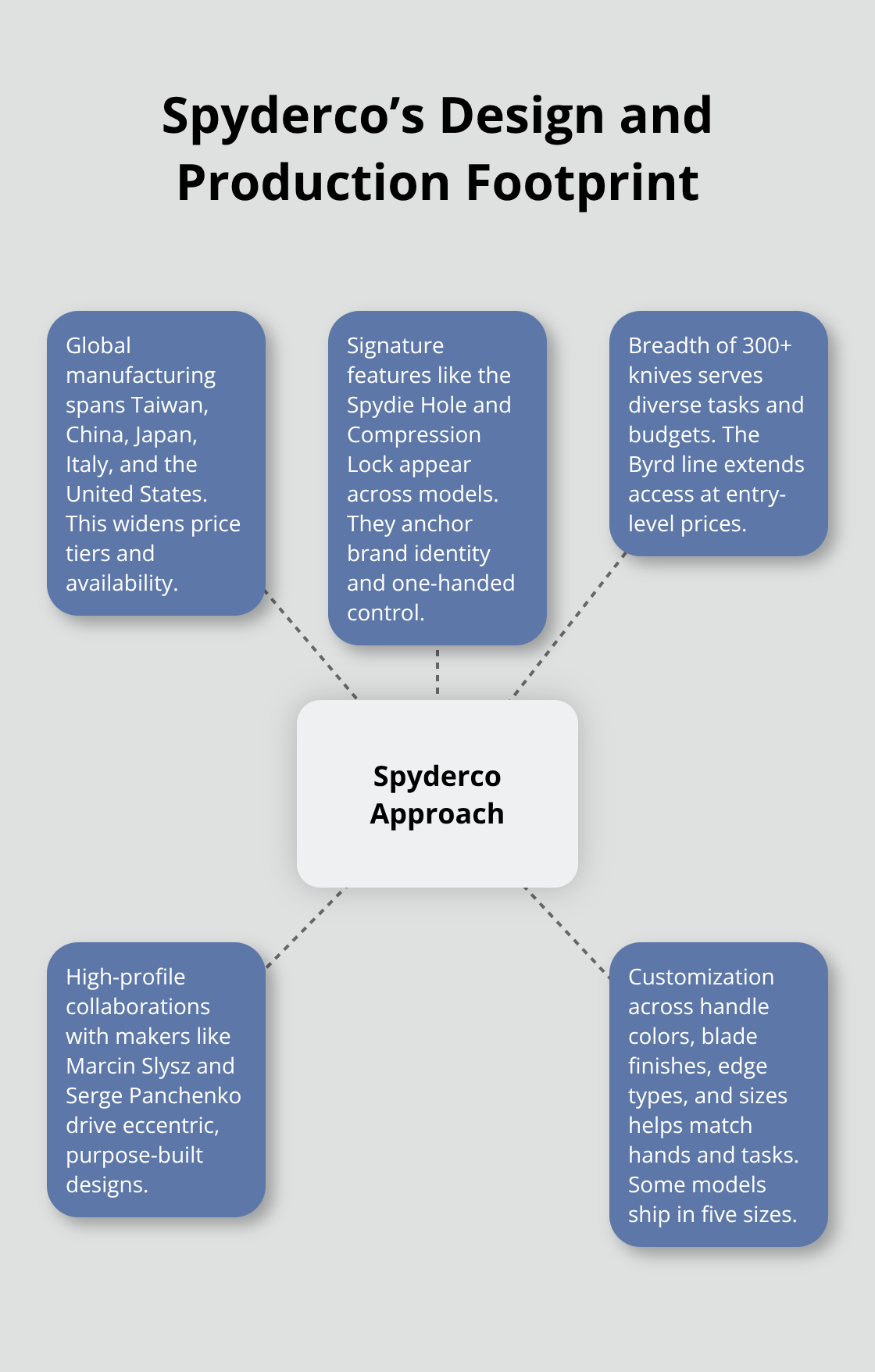
Spyderco takes the opposite approach and offers 300+ knives across multiple price tiers, manufacturing in Taiwan, China, Japan, and Italy alongside US production. The company runs budget lines like Byrd Knives, produces kitchen knives and sharpening tools, and embraces eccentric design through collaborations with makers such as Marcin Slysz and Serge Panchenko. Spyderco’s signature Spydie Hole and Compression Lock appear across models because they represent the brand’s core identity, yet the company varies handle colors, blade finishes, edge types, and even sizes-some models ship in five different sizes to match specific hands and tasks.
Accessibility and Specialization
Sprint Run limited editions feature different steels and handle materials at lower price points than Benchmade’s Gold Class, making collectibility more accessible. Spyderco emphasizes the Salt Series for maritime use and prioritizes left-handed versions on popular models, signaling that accessibility matters as much as innovation. The brand’s willingness to experiment means some designs feel quirky or niche, but knife enthusiasts often own both brands because Spyderco’s width and eccentricity fill gaps that Benchmade’s sleeker, more conservative lineup cannot address. Many users choose Benchmade for refined everyday carry and Spyderco for specialized tasks or unconventional preferences-a pattern that sets the stage for understanding which brand truly suits your needs.
Blade Steel, Design, and Real-World Performance Comparison
Steel Selection: Consistency Versus Experimentation
Benchmade and Spyderco diverge sharply when it comes to steel selection and blade geometry. Benchmade standardizes on proven mid-range stainless steels like 154CM and S30V across its core lineup, prioritizing corrosion resistance and ease of maintenance over edge-retention longevity. This choice reflects the brand’s philosophy: a knife that stays sharp long enough for a week of hard use, then returns for factory sharpening through Benchmade’s LifeSharp program, which provides free sharpening, cleaning, oiling, and adjustment for the lifetime of your knife. Spyderco, conversely, experiments aggressively with steel options.
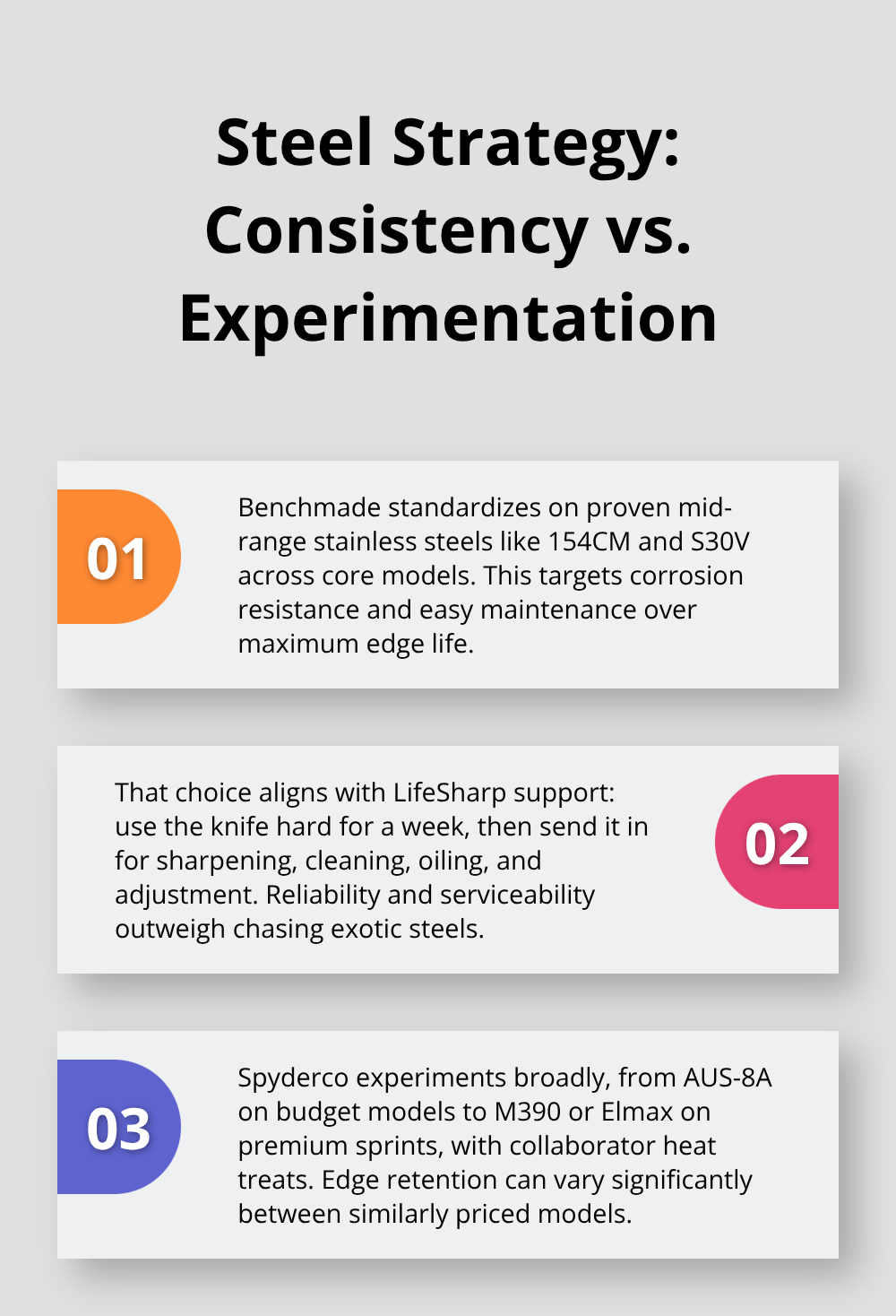
The brand pairs budget models with Japanese AUS-8A, reserves premium sprints for exotic choices like M390 or Elmax, and even applies proprietary heat treats on collaborator designs from makers like Marcin Slysz. Two Spyderco knives at similar price points may hold an edge for vastly different durations depending on the specific sprint run you select.
Handle Design: Refinement Versus Control
Handle design exposes the deepest philosophical split between these brands. Benchmade knives feel refined because the company obsesses over ergonomic curves, textured overlays, and weight distribution that reward extended carry without fatigue. The Bugout’s 1.85 oz weight and tapered scales feel premium because Benchmade invested years refining the geometry for comfort during all-day EDC use. Spyderco embraces wider, more aggressive handle profiles that prioritize grip security over sleekness. The Salt Series models, designed for maritime and wet environments, feature pronounced texturing and larger surface areas that demand more pocket space but deliver superior control when hands are wet or gloved. A Spyderco Shaman feels chunky next to a Benchmade Narrows, yet in actual cutting scenarios where leverage and control matter, the Shaman’s geometry wins.
Performance in the Field
Real-world performance testing reveals this trade-off clearly: Benchmade’s refined designs excel at repetitive cuts in controlled settings like kitchen work or camp tasks, while Spyderco’s eccentric proportions dominate in high-stress, unpredictable environments where grip security and blade angle matter more than comfort. For hunters and outdoor users who sharpen in the field, Spyderco’s variety creates both opportunity and confusion. Benchmade’s consistency removes guesswork but locks you into the brand’s maintenance ecosystem. Benchmade users praise their knives for feeling like an extension of the hand. Spyderco users praise theirs for never slipping when precision cuts demand absolute control. Blade geometry and edge thickness win real-world cuts far more than steel grades alone, a reality both brands acknowledge through their design priorities.
Understanding these performance differences matters because your primary use case-whether EDC, hunting, or specialized tasks-determines which brand’s approach serves you better. The next section examines how price, warranty coverage, and customer support reinforce these philosophical differences and help you calculate true long-term value.
Price, Value, and Warranty Support
Benchmade’s entry point sits firmly at £100 and climbs steeply from there, with mid-range models landing between £150 and £300, while premium Gold Class editions exceed £600. This pricing reflects the company’s Oregon City manufacturing footprint and refusal to compromise on labor costs for domestic production. Spyderco’s range sprawls across every price tier imaginable: budget Byrd knives start under £50, mainstream models occupy the £80 to £180 window, and Sprint Run limited editions hover between £150 and £250 depending on steel and handle choices. This structural difference means Benchmade forces a choice between their specific design philosophy or nothing at all, while Spyderco lets you enter the brand ecosystem at virtually any budget. For hunters on tight budgets, Benchmade’s Taggedout delivers genuine hunting capability at approximately £180 with a 3.5-inch blade and high-visibility orange handle, representing genuine value in a limited product line. Spyderco counters with dozens of options at that price, from the Para 3 Lightweight to regional variants with different steels, making budget shopping simultaneously easier and more confusing. The Benchmade Bugout at roughly £100 to £130 remains the strongest value proposition in American-made EDC knives, offering lightweight design and proven reliability without the premium materials that justify Gold Class pricing.
Benchmade’s LifeSharp Program Transforms Maintenance Economics
Benchmade’s LifeSharp program separates this brand from competitors because it transforms maintenance into a genuine lifetime service. Mail your Benchmade knife to Oregon City, and the company sharpens, cleans, oils, and adjusts it for free indefinitely, shipping it back without charge. This eliminates the hidden cost of professional sharpening that accumulates over years of ownership, making a £200 Benchmade genuinely cheaper than a £120 Spyderco when you account for five years of maintenance. Spyderco offers a lifetime warranty on defects but provides no sharpening program, meaning you either sharpen in-house with stones or pay professional rates every 12 to 18 months depending on use intensity.
Long-Term Ownership Costs Favor Different Brands
For hunters processing game regularly or outdoor users who sharpen frequently, Benchmade’s approach saves hundreds of pounds over a decade. Spyderco’s warranty covers manufacturing defects generously, yet you absorb all maintenance costs yourself. This distinction matters most for users who plan to carry the same knife for years rather than rotate through collections. Field & Stream’s testing confirmed that even premium stainless steels require maintenance, noting that rust spots appear on neglected blades regardless of grade. Benchmade users enjoy free rust removal and touch-ups; Spyderco users handle this independently or pay shop rates.
Budget Tiers Determine Your Best Options
Under £100, Spyderco dominates through Byrd knives and lightweight models that Benchmade refuses to produce at that price point, making this tier exclusively Spyderco territory for budget-conscious buyers. Between £100 and £200, both brands compete directly, though Benchmade offers fewer choices and Spyderco’s variety creates decision paralysis. The Benchmade Bugout and Spyderco Para 3 Lightweight occupy this space as the definitive mid-weight EDC options that knife enthusiasts own simultaneously.
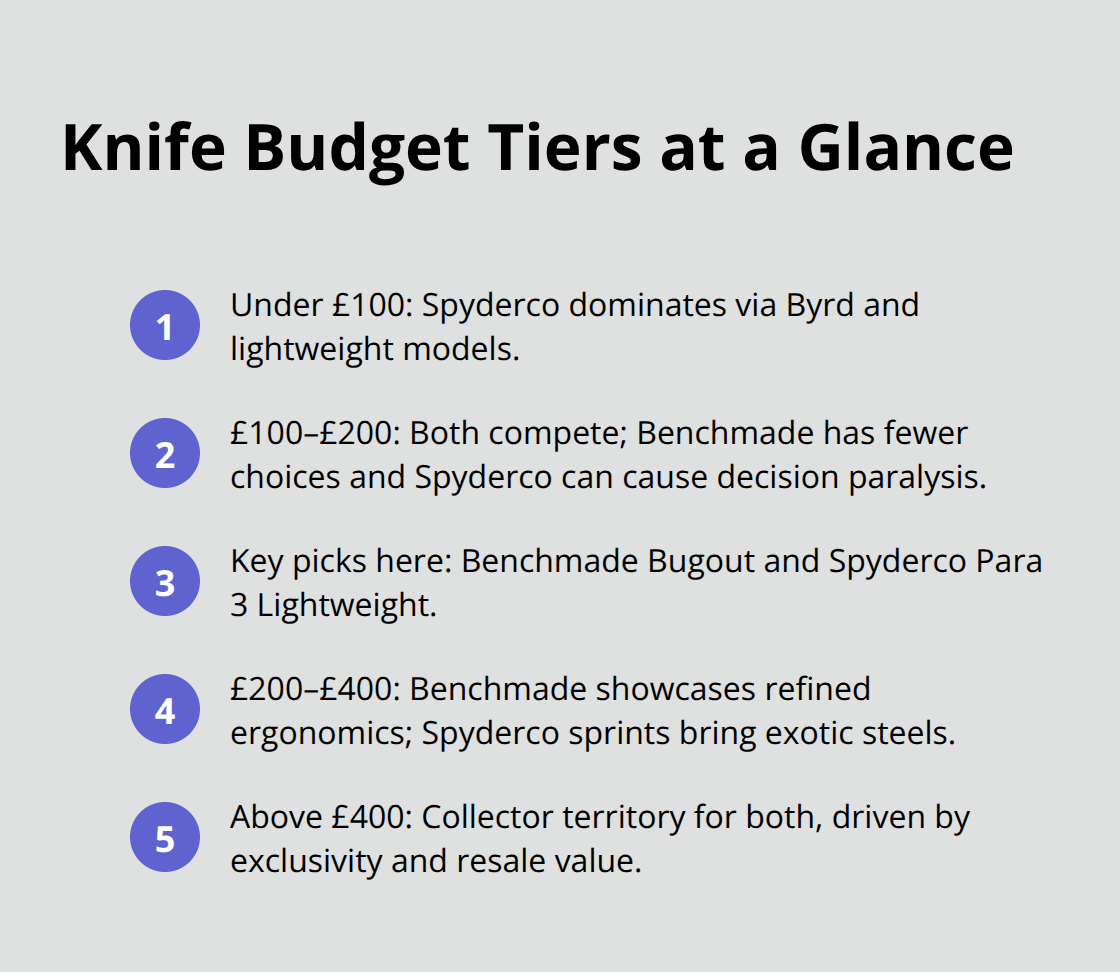
At £200 to £400, Benchmade’s refined mid-range models like the Narrows showcase premium materials and refined ergonomics that justify pricing, while Spyderco’s Sprint Run editions offer exotic steels and limited-run appeal without Benchmade’s material premium. Above £400, Benchmade’s Gold Class and Spyderco’s highest-tier Sprint Runs target collectors rather than users, with resale value and exclusivity driving purchasing decisions more than practical performance.
Calculate True Cost Over Time, Not Just Sticker Price
Your true decision framework should anchor on brand reputation and warranty support, not sticker price alone. A Benchmade at £200 costs less over ten years than a Spyderco at £120 when LifeSharp sharpening saves you money across dozens of sharpenings. Conversely, Spyderco’s lower entry price and design variety justify the maintenance cost if you value experimentation over long-term commitment to a single blade.
Final Thoughts
Benchmade versus Spyderco comparison ultimately reveals two distinct philosophies that serve different knife users. If American manufacturing, proven reliability, and lifetime maintenance support appeal to you, Benchmade delivers a complete ownership experience where your knife improves with age. The Bugout remains the gold standard for everyday carry, and models like the Narrows reward users who prioritize comfort and refined ergonomics. Benchmade suits professionals, hunters who sharpen infrequently, and anyone who plans to carry the same knife for years without rotation.
Spyderco appeals to knife enthusiasts who crave design diversity, experimental materials, and accessibility across price tiers. The brand’s 300+ models, Sprint Run limited editions, and willingness to vary handle colors, blade finishes, and sizes mean you find exactly what you need rather than compromising on Benchmade’s narrower vision. Spyderco excels for specialized tasks like maritime work, left-handed users seeking true ambidextrous options, and collectors who enjoy rotating through different designs. The lower entry price and eccentric proportions attract users who value control and grip security over refined comfort.
Your decision depends on identifying your primary use case, assessing whether you prefer long-term commitment to a single refined blade or experimentation across multiple designs, and calculating whether free lifetime sharpening justifies Benchmade’s higher sticker price for your ownership timeline. Many knife enthusiasts own both brands because they solve different problems-the Benchmade handles refined everyday carry while the Spyderco tackles specialized work or unconventional preferences. Test both brands’ ergonomics in hand before deciding, and visit Benchmade’s official site to explore their current lineup and discover which blade truly matches your needs.