
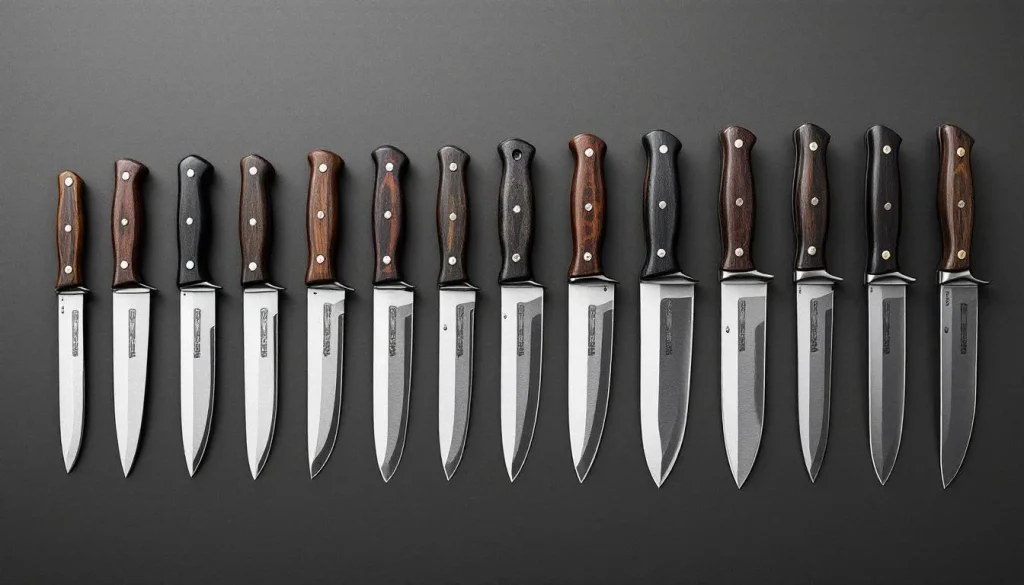

ESEE fixed blades have earned their reputation through decades of real-world use by hunters, outdoor professionals, and serious EDC enthusiasts. Whether you need a compact everyday carry knife or a heavy-duty tool for wilderness tasks, ESEE offers proven options built to last.
This ESEE fixed blade comparison cuts through the noise and helps you find the right model for your specific field needs. We’ll walk you through design philosophy, popular models, and practical selection criteria so you can make a confident choice.
ESEE Fixed Blades: Built for Durability and Real-World Performance
Philosophy: Simplicity Over Complexity
ESEE fixed blades follow a straightforward engineering philosophy: simplicity and reliability trump everything else. The company strips away unnecessary features and focuses on materials, construction methods, and design details that directly impact field performance and longevity. This approach means every ESEE knife prioritizes toughness and ease of maintenance over cutting-edge metallurgy or flashy aesthetics. The result is a tool that works in harsh conditions, survives hard use, and sharpens with basic equipment in remote locations.
Full Tang Construction and Materials
ESEE manufactures in the USA with full tang construction as standard, meaning the steel runs continuously from blade tip through the handle. This design eliminates weak points and distributes stress evenly, making the knife nearly impossible to snap or separate under impact. The heavy powder coat finish adds corrosion resistance without compromising the tactile feel of the blade, and the micarta or G-10 handles provide reliable grip even when wet or muddy.
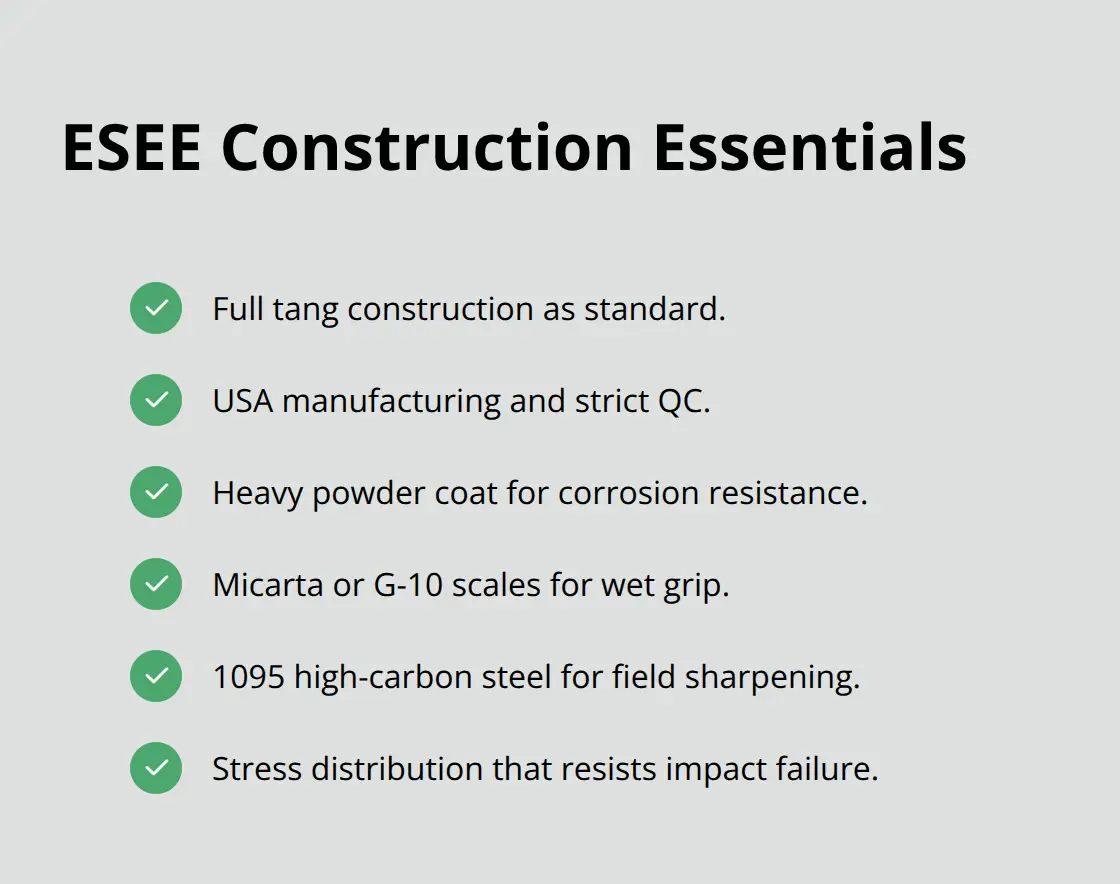
ESEE primarily uses 1095 high-carbon steel because it sharpens quickly in the field with basic whetstones, takes and holds a razor edge at practical angles, and forgives hard use better than brittle, high-hardness alternatives. The trade-off is that 1095 sacrifices corrosion resistance for toughness and simplicity, but the powder coat mitigates this risk significantly. Keeping a blade lightly oiled after use remains a realistic maintenance routine for serious outdoors people.
Blade Geometry and Task-Specific Design
Blade length, thickness, and grind choice directly determine what the knife does best. Longer blades like the ESEE-6 provide leverage for chopping and camp work; shorter blades like the ESEE-3 excel at precision tasks and pack lighter. Thicker blades resist damage from batoning and heavy-duty abuse, while thinner blades favor slicing and reduce overall weight. ESEE offers flat, hollow, convex, and scandi grinds depending on the model, each influencing edge retention and sharpening approach.
The ESEE-4 uses a robust convex grind that resists dulling under real-world cutting, while the Camp-Lore Bolieu RB3 employs a scandi grind optimized specifically for wood processing and bushcraft tasks. Field testers consistently report that ESEE knives maintain usable edges longer than comparably priced alternatives because the geometry and steel work together intentionally.
Warranty and Long-Term Confidence
The unconditional lifetime warranty reinforces the company’s confidence in durability. No questions asked, no receipts required, no time limit-ESEE will repair or replace any knife that fails. This guarantee transfers with ownership, meaning a used ESEE knife carries the same protection as a new one. For hunters, backcountry users, and serious EDC fans, this warranty removes the financial risk of choosing a knife that might not survive your actual field demands.
With durability and design philosophy established, the next step is understanding which ESEE models match your specific needs and how their individual strengths translate to real-world performance.
ESEE Models That Match Your Field Reality
The ESEE-3 and ESEE-4: Versatility Meets Carry Comfort
The ESEE-3 and ESEE-4 form the backbone of the lineup for users who prioritize carry comfort and versatility. The ESEE-3 weighs just 6 ounces with a 3.875-inch blade, making it genuinely packable in a vest pocket or on a neck strap without fatigue during long days afield. The ESEE-4 steps up to 8 ounces and a 4.5-inch blade, delivering significantly more steel for wood processing and batoning tasks while remaining manageable for belt carry. Field experience shows the ESEE-4 appeals to hunters and hikers who want one knife that handles fire prep, game processing, and camp chores without compromise.
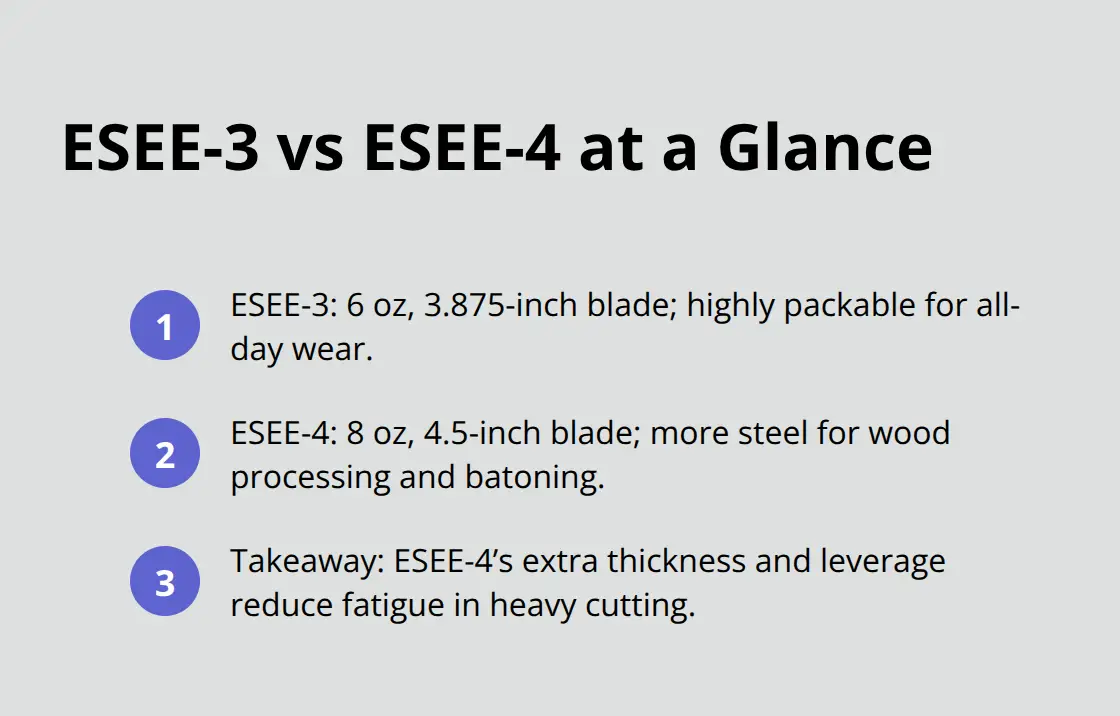
The ESEE-3 works best for users with smaller hands or those who prioritize ultralight setups, though its thinner profile means it struggles with sustained heavy cutting compared to the 4. Both use 1095 steel and ship with reliable Micarta handles, but the real difference lies in thickness and leverage-the ESEE-4’s extra blade mass translates directly to less fatigue when you process wood or clear brush for hours. Premium ESEE-3 variants feature CPM-S35VN steel, which offers superior edge retention but adds weight and cost that most field users do not need.
The ESEE-5 and ESEE-6: Power and Reach for Wilderness Work
The ESEE-5 and ESEE-6 exist for serious wilderness work where durability and reach dominate the decision. The ESEE-6 carries a 5.625-inch blade and 7.2 ounces, striking a practical balance between leverage and pack weight that appeals to camp-based users and backcountry expeditions. The ESEE-5 flips the equation entirely-nearly double the weight at 13.2 ounces with only a modestly longer blade, delivering exceptional thickness that resists damage when you baton large diameter wood or process tough game. Users often describe the ESEE-5 as nearly indestructible, though that durability demands intentional carry planning. Choose the ESEE-5 when toughness matters more than portability; choose the ESEE-6 when you need substantial reach without sacrificing packability.
Specialized Models for Dedicated Tasks
Specialized models like the Junglas target extreme scenarios-its 10.375-inch blade and 1.6-pound weight make it a dedicated camp tool rather than a general-purpose knife, best reserved for users who establish a base camp and rely on one heavy-duty blade for all cutting tasks. The Camp-Lore Bolieu RB3 introduces a Scandi grind optimized for wood processing, making it the strongest choice for bushcraft-focused users who spend time on axe work and feather stick preparation. Its 3.5-inch blade and 5.87-ounce weight position it between the ESEE-3 and ESEE-4, offering experienced users superior edge geometry for their specific tasks without the compromise of general-purpose grinds.
Understanding these models sets the stage for the next critical step: matching your actual field conditions, intended tasks, and carry constraints to the right blade. The following section walks you through the selection criteria that separate the perfect knife from the merely adequate one.
Matching Your Field Reality to the Right Blade
Blade Length and Weight: The Foundation of Your Choice
The gap between owning an ESEE knife and owning the right ESEE knife for your actual needs determines whether you reach for it consistently or watch it gather dust. Blade length and weight form the foundation of this decision, and they track directly to your carry method and expected workload. A 6-ounce ESEE-3 disappears into a vest pocket or hangs comfortably on a neck strap for all-day wear, while an 8-ounce ESEE-4 demands belt carry consideration and adds noticeable fatigue over twelve hours of hiking. The ESEE-5 at 13.2 ounces and ESEE-6 at 7.2 ounces represent completely different carry philosophies: the 5 lives in a pack or stays basecamp-bound, the 6 suits backpacking where you want substantial reach without constant weight redistribution. Blade length compounds this equation because longer blades provide leverage for chopping and batoning large wood, while shorter blades excel at processing game, food prep, and precision camp tasks. The practical threshold sits around 4 inches for belt carry comfort; anything longer than 5 inches forces pack carry or basecamp use unless you accept significant carry fatigue.
Task-Specific Selection: Matching Knife to Work
Your actual field days matter more than theoretical capability. A hunter covering ten miles daily needs the ESEE-3 or ESEE-4, while a backcountry camper processing firewood for three days straight benefits from the ESEE-6’s reach or ESEE-5’s durability. Hunters processing game in wet conditions should prioritize the ESEE-4 because its 4.5-inch blade handles field dressing efficiently, its 1095 steel sharpens quickly with basic equipment when dulled by bone contact, and its weight remains manageable during long pack-outs. Bushcraft users focusing on wood processing and shelter construction gain substantially from the Camp-Lore Bolieu RB3 and its scandi grind, which performs measurably better at feather sticks and axe work than the flat grind of the ESEE-4.
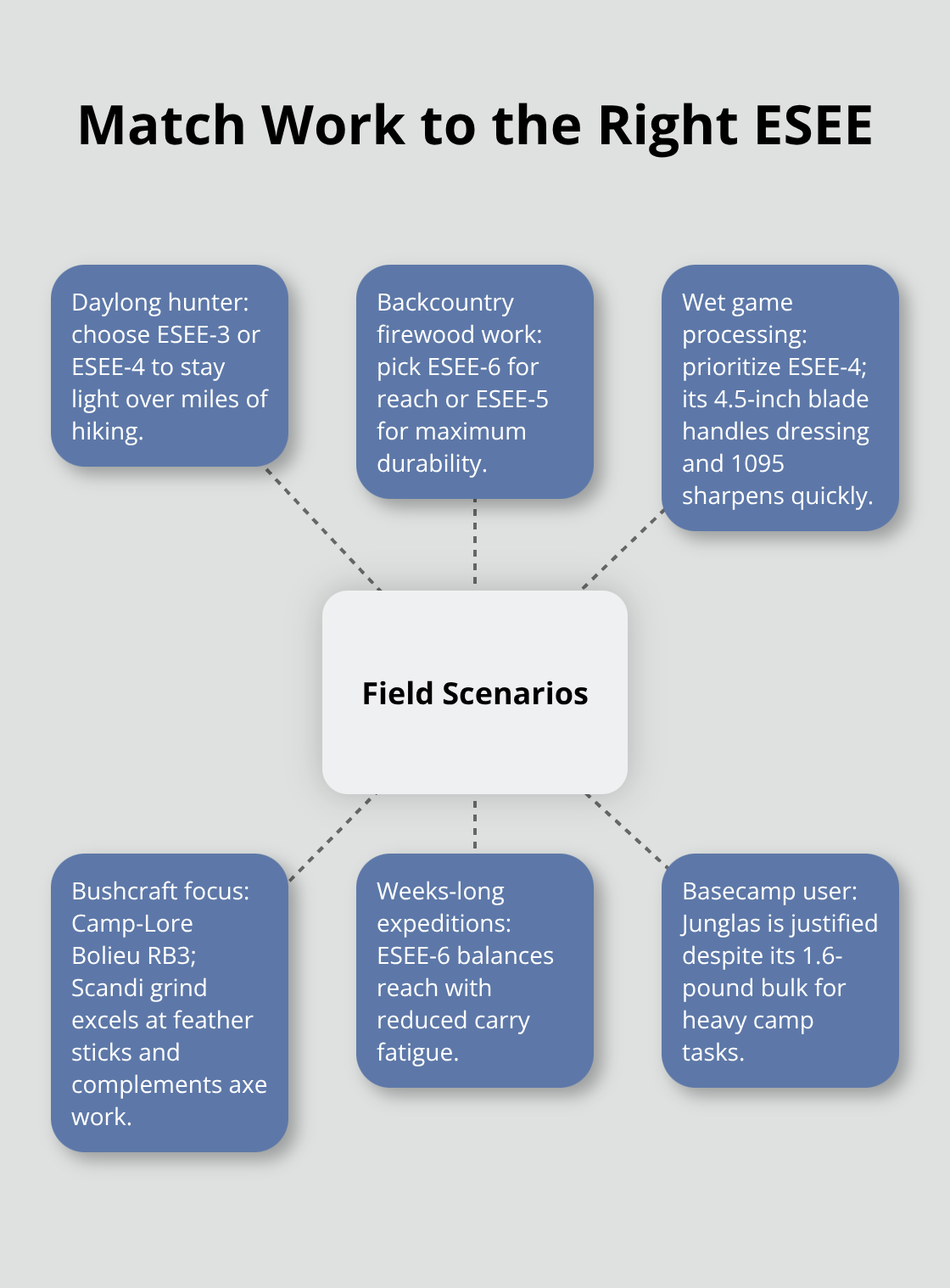
Wilderness expeditions lasting weeks demand the ESEE-6 because its balance of reach and weight prevents fatigue from constant carry, while dedicated basecamp scenarios justify the Junglas despite its 1.6-pound bulk.
Environmental Conditions and Steel Performance
Corrosion exposure shifts steel priorities significantly. Coastal environments and saltwater exposure argue for exploring alternatives beyond standard 1095 because the powder coat alone cannot guarantee rust-free performance, though most ESEE users accept occasional light oiling as maintenance cost. Cold-weather use favors thicker blades and heavier models because brittle performance matters less with 1095 than with premium stainless steels, and the ESEE-5’s exceptional thickness resists chipping when frozen ground resists cutting. These environmental factors shape which model performs reliably in your specific climate and conditions.
Budget and Long-Term Value Alignment
Budget and long-term value align perfectly because ESEE knives hold resale value consistently, and the unconditional lifetime warranty means your initial purchase decision carries no financial risk of failure. The ESEE-3 at roughly 100 dollars and the Izula-II at significantly less deliver genuine all-around capability without compromise, while premium variants with CPM-S35VN steel cost substantially more without delivering proportional field advantage for most users. Serious outdoors people typically invest in multiple ESEE models over time rather than searching for one perfect knife, testing the ESEE-3, ESEE-4, and ESEE-6 in actual field conditions before settling on primary and backup options that match their specific seasons and tasks.
Final Thoughts
ESEE fixed blades succeed because they prioritize what actually matters in the field: durability, simplicity, and honest performance under real conditions. The ESEE-3 delivers compact versatility for hunters and hikers who value portability without sacrificing capability, while the ESEE-4 stands as the all-around workhorse that handles everything from game processing to firewood preparation with equal competence. The ESEE-5 and ESEE-6 serve users whose tasks demand substantial reach or exceptional toughness, and specialized models like the Junglas and Camp-Lore Bolieu RB3 address dedicated scenarios where task-specific design matters more than general-purpose compromise.
This ESEE fixed blade comparison reveals a consistent pattern: the right knife depends entirely on your actual field demands, not theoretical capability. A basecamp user benefits from the ESEE-6’s leverage and reach, while a backcountry hunter gains more from the ESEE-4’s balance of weight and function. Budget-conscious users find genuine capability in the ESEE-3 or Izula-II without feeling they sacrificed performance, and serious outdoors people typically own multiple ESEE models, testing each in real conditions before settling on primary and backup options that match their specific seasons and tasks.
ESEE remains trusted by outdoor professionals, military personnel, and experienced hunters because the company refuses to chase trends or compromise on manufacturing standards (full tang construction, USA manufacturing, heavy powder coats, and 1095 steel that sharpens in the field with basic equipment). The unconditional lifetime warranty removes financial risk and reinforces confidence in durability, so when you choose an ESEE knife, you invest in a tool that works reliably in harsh conditions and maintains usable edges longer than comparably priced alternatives. Explore our current ESEE inventory to find the model that matches your field reality and start building your trusted knife collection today.