

Spending a thousand dollars on a knife might sound excessive, but knives under thousand dollars often deliver professional-grade performance without the premium price tag. The sweet spot between budget and quality exists-you just need to know what to look for.
This guide walks you through steel quality, blade geometry, handle durability, and real-world performance so you can confidently choose a knife that matches your needs and budget. Whether you’re hunting, working outdoors, or building an EDC collection, the right knife under a thousand is out there.
What Separates Under-$1000 Knives From Cheap Alternatives
Steel Quality and Heat Treatment
Steel quality determines whether a knife holds an edge for months or weeks, and under $1000, you have access to genuinely premium alloys that rival knives costing double. MagnaCut stands out as the best-balanced stainless option for under-$1000 production knives, combining corrosion resistance with solid toughness and edge retention without the maintenance demands of carbon steels. S90V and S35VN deliver excellent edge retention while maintaining reliable corrosion resistance, though S90V requires more careful sharpening. M390 pushes edge retention to exceptional levels with outstanding wear resistance, but costs climb quickly. For non-stainless options, CPM-CruWear and CPM-4V offer dependable all-around performance when you prioritize toughness over maximum edge retention.
The critical insight: hardness alone means nothing. Steel quality and heat treatment matters as much as the steel itself-two knives using identical steel can perform drastically differently based on how the manufacturer tempers the blade. Look for makers known for consistent heat treatment rather than chasing the theoretically hardest steel.
Blade Geometry for Real-World Performance
Blade geometry and edge thickness wins real-world cuts far more than steel grades alone. A razor-thin edge delivers immediate cutting feel, but it chips easily under pressure; thicker edges sacrifice initial sharpness for durability during heavy use. The geometry sweet spot depends on your task: fine food prep demands acute angles, while game processing and field work need thicker stock to survive impact.
Handle Design and Construction
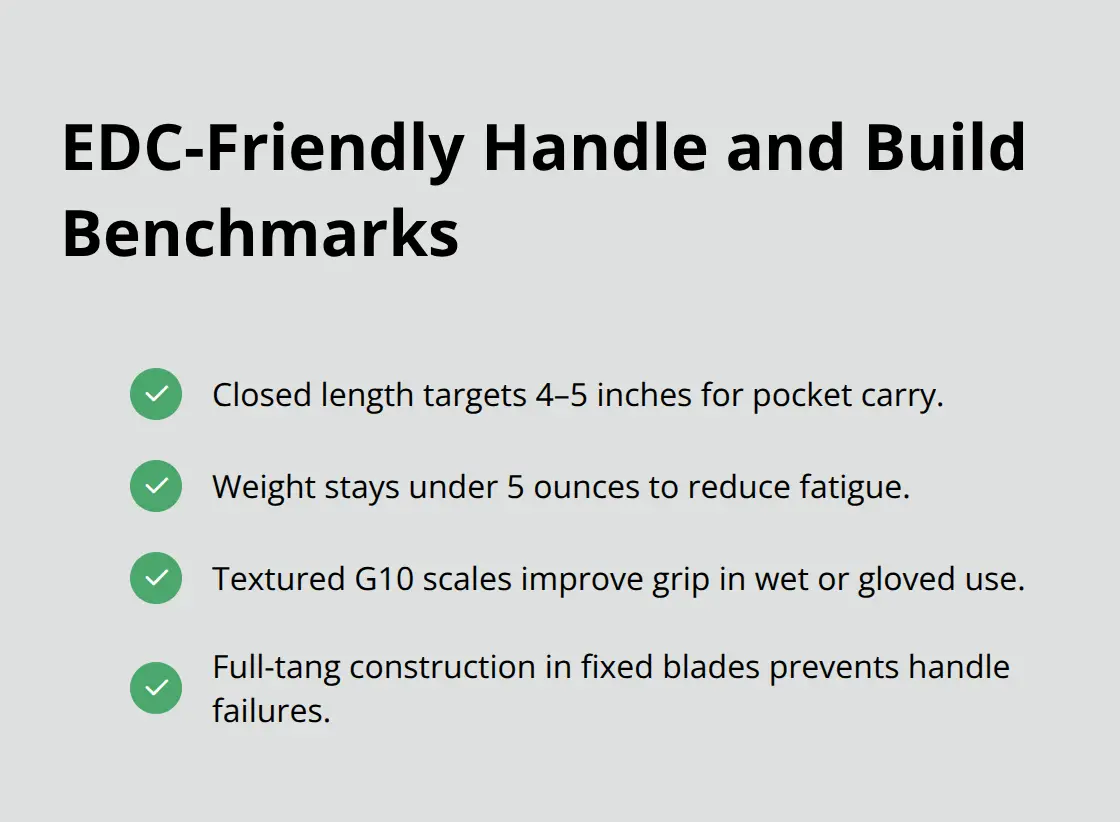
Handle ergonomics separate knives you’ll actually carry from expensive paperweights. Closed length should land between 4–5 inches for pocket carry, with weight under 5 ounces to avoid fatigue during extended use. Textured G10 scales outperform smooth aluminum or plastic for wet conditions and gloved hands, while full-tang construction in fixed blades distributes stress and prevents handle failures during heavy field work.
Folding mechanisms introduce failure points that fixed blades eliminate, so serious wilderness work demands a fixed blade despite the portability tradeoff. This distinction shapes your next decision: whether a fixed or folding design truly matches your intended use.
Choosing Between Fixed and Folding Designs
Fixed Blades for Serious Field Work
Fixed blades under $1000 dominate serious field work because they eliminate folding mechanisms entirely, removing the primary failure point that costs lives in wilderness scenarios. A fixed blade with full-tang construction distributes stress evenly through the handle and into your grip, allowing you to process game, split kindling, and perform heavy chopping without risk of the blade separating from the handle. Fixed blades cost more upfront because manufacturers invest in proper tang construction and heat treatment without the cost-cutting shortcuts that plague budget folders. If your primary use is hunting, game processing, or extended camping, invest in a fixed blade first.
Folding Knives for EDC and Light Tasks
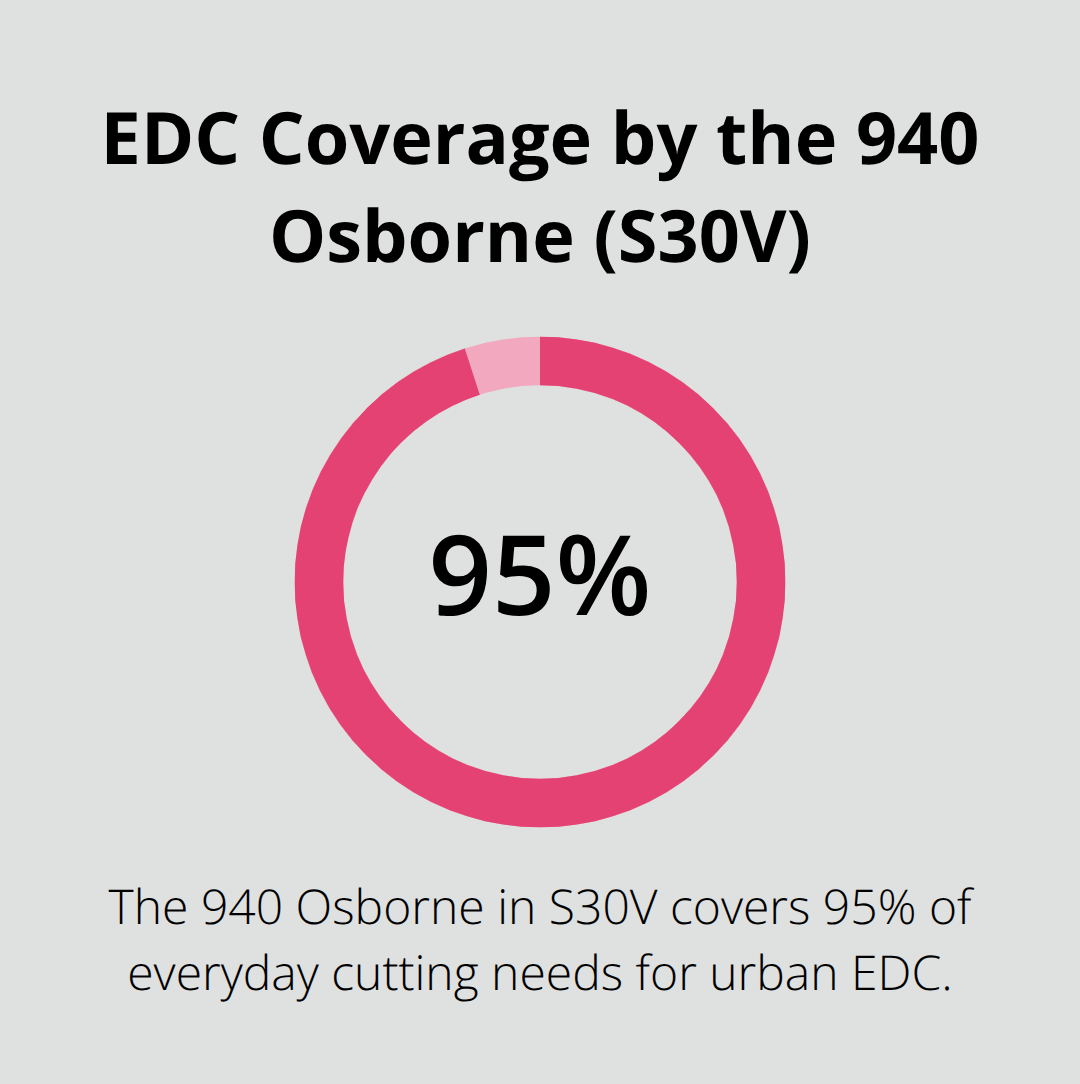
Folding knives excel at EDC and light camp tasks-cutting rope, opening packages, food prep-where blade lengths stay under 3.5 inches and abuse remains minimal. The Benchmale 940 Osborne in S30V (roughly $200–$240) handles 95 percent of daily cutting needs with pocket carry convenience.
Folding mechanisms introduce dirt traps, rust vulnerability in wet conditions, and potential lock failure during critical moments-factors that matter little in an urban environment but become life-threatening during multi-day backcountry trips. If you carry daily in an urban setting, a quality folder covers your needs completely.
Owning Both Categories
The honest truth: most knife users benefit from owning both. A folding knife provides the reliability you need for daily carry, while a fixed blade like the Bradford Guardian 3 in M390 (around $170) provides the reliability you need when serious wilderness work demands a tool that won’t fail. This dual approach eliminates compromise and lets each knife excel in its intended environment.
Tactical Folders and Survival Performance
Tactical and survival knives under $1000 occupy a murky middle ground where marketing often exceeds practical performance. The Kershaw Bel Air in MagnaCut steel (around $165) delivers tactical aesthetics with genuine performance-MagnaCut’s balanced properties handle both fine slicing and abuse without the maintenance demands of exotic steels. Most tactical folders fail in the field because they prioritize speed deployment and aggressive styling over ergonomic reliability; a knife you can’t control comfortably becomes dangerous, not useful. Survival knives specifically designed for wilderness work need blade lengths between 4–6 inches with thickness around 4–5mm to handle batoning, food processing, and shelter construction without flexing or breaking.
Avoiding Compromise Designs
The Spyderco Para 3 Lightweight in CTS BD1N (roughly $130–$160) proves that sub-$200 folders can deliver genuine field capability when designers prioritize geometry and steel quality over unnecessary features. Avoid knives marketed as “tactical survival” that combine folding mechanisms with survival-knife proportions-this compromise satisfies neither category. Instead, choose a dedicated fixed blade for survival work or a proven folding design optimized for your actual environment. Understanding these distinctions shapes how you evaluate the specific models and brands that align with your intended use case.
How to Choose the Right Knife Under $1000
Identify Your Primary Cutting Tasks
The most expensive knife fails if it doesn’t match how you actually use it. Start by identifying your primary cutting task, not your fantasy use case. If you process game twice a year but carry a knife daily in an office, your budget should prioritize EDC performance first.
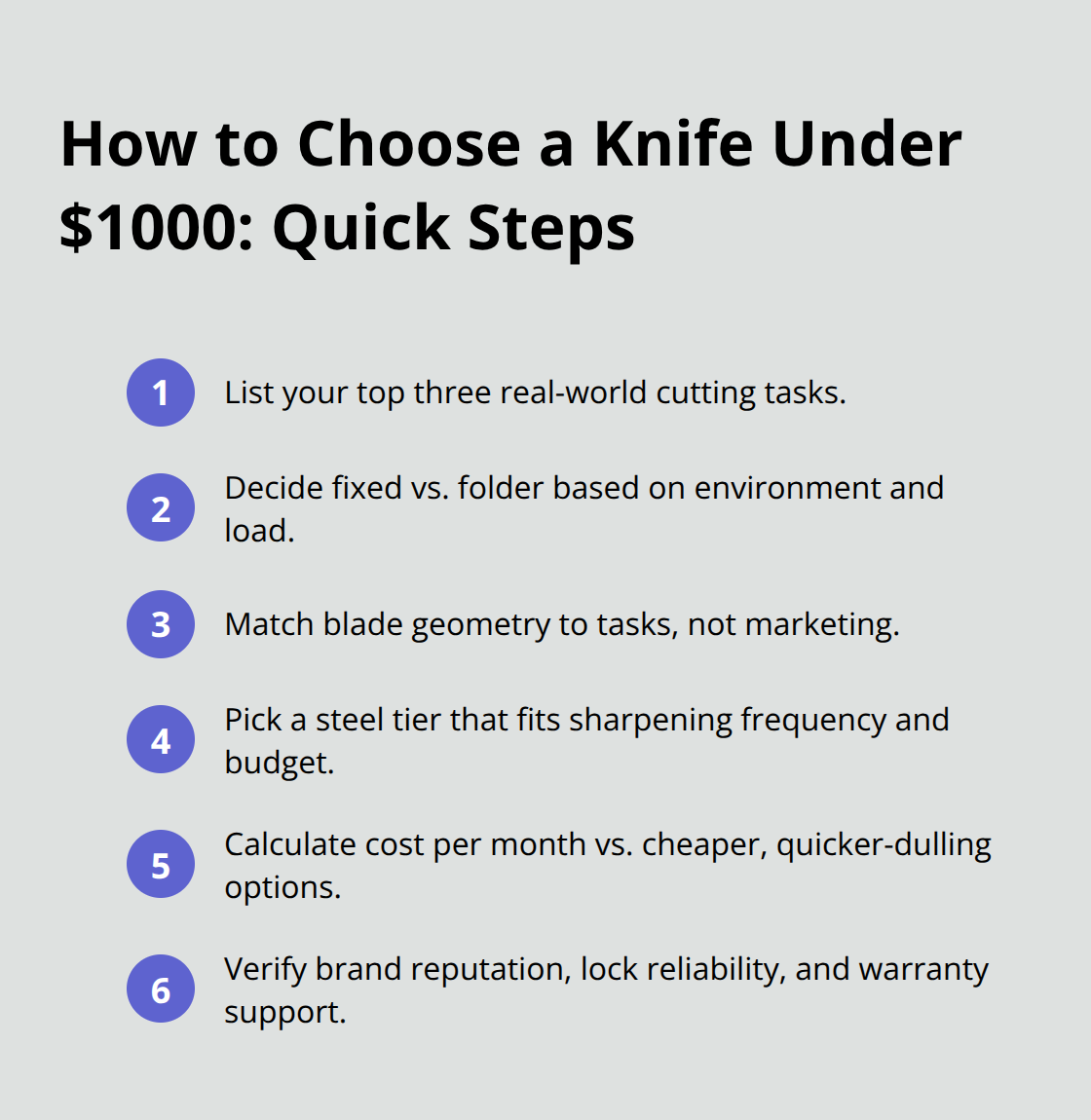
Hunters often overestimate how much blade they need; most field dressing happens with a 3.5–4 inch fixed blade, yet they purchase 6-inch beasts that spend months unused. Outdoor workers in construction or forestry demand different geometry than bushcraft enthusiasts. Write down your three most frequent cutting tasks, then evaluate knives against those specific scenarios rather than marketing promises.
Steel Grade and Price Relationships
The relationship between steel grade and price under $1000 reveals where manufacturers spend your money wisely and where they don’t. MagnaCut and S35VN knives typically land between $130–$250 because the steel itself costs significantly more than 8Cr13MoV or 14C28N, yet the real-world performance gain justifies the jump for serious users who sharpen monthly. M390 options push toward $400–$600 because the steel demands premium heat treatment and specialized manufacturing, but this tier makes sense only if you cut abrasive materials like cardboard, rope, or wet wood regularly. For EDC and general cutting, S35VN delivers good edge retention, toughness, and corrosion resistance, while budget options like 14C28N require sharpening every 2–3 months despite lower initial cost.
Calculate your true cost per month by dividing the knife price by expected months before professional sharpening becomes necessary, then compare across price points. A $200 knife needing sharpening twice yearly costs less per month than an $80 knife requiring sharpening every six weeks. This calculation reveals that premium steels often represent better value than initial sticker prices suggest.
Brand Reputation and Warranty Support
Brand reputation matters far more than individual model hype because heat treatment and quality control separate knives that perform as advertised from expensive disappointments. Benchmade’s AXIS lock mechanism has proven reliable across thousands of field hours, making their $190–$240 folders predictable investments despite higher prices. Cold Steel’s Tri-Ad Lock similarly delivers proven reliability, though their customer service reputation remains mixed. Kershaw’s sub-$200 options like the Bel Air prove that mid-tier manufacturers can execute premium steel properly, but their warranty support lags behind established names.
Research actual warranty claims through knife forums and communities rather than manufacturer websites; a lifetime warranty means nothing if the company refuses claims or charges $80 for service. Spyderco’s back lock mechanism requires no spring tension, eliminating a common failure point, which explains why their Para 3 Lightweight maintains value and user loyalty despite premium pricing. Avoid brands with minimal online reviews or no clear warranty terms; these red flags indicate either new entrants cutting corners or established companies protecting themselves because failures happen frequently. Spend 30 minutes reading user reports on dedicated knife communities about specific models before committing to a purchase, as real-world failure rates often diverge sharply from marketing claims.
Final Thoughts
Finding the right knife under a thousand dollars means matching steel quality, blade geometry, and handle design to your actual cutting tasks instead of chasing marketing hype or theoretical performance metrics. The knives under thousand that deliver genuine value prioritize heat treatment consistency, proven lock mechanisms, and ergonomic reliability over unnecessary features or exotic materials that inflate prices without improving real-world performance. Your investment in quality pays dividends through reduced maintenance costs, longer intervals between sharpening, and the confidence that your knife performs predictably when it matters most.
A $200 folder in MagnaCut or S35VN holds an edge for months and costs significantly less per month than a $60 budget knife requiring sharpening every few weeks. Similarly, a $170 fixed blade in M390 with full-tang construction eliminates the anxiety of folding mechanism failure during critical field work, making the upfront cost irrelevant compared to the reliability it provides. Most knife users benefit from owning both a quality folding knife for EDC and a fixed blade for serious outdoor work, yet this dual approach still costs less than purchasing five budget alternatives that disappoint individually.
Start with your most frequent cutting task, research brand reputation through user communities rather than marketing claims, and verify warranty support before committing to a purchase. Explore our knife reviews to compare specific models and find the tool that matches your needs. The right knife under a thousand exists for your specific requirements-take time to identify what those needs actually are, then let steel quality, proven designs, and manufacturer reliability guide your decision.