

Best Diamond Stones for S90V, M390 and More
The quick answer
For daily EDC users who work with high-carbide stainless steels like S90V and M390, pick a diamond plate that balances bite with even wear. Our compact conclusions: the Atoma 400 Diamond Plate is the fastest cutter and most aggressive for initial apexing; the DMT DuoSharp Diamond Bench Stone is the best all-rounder for bench and freehand work; the Sharpal 162N Diamond Stone is the most budget-friendly option with decent consistency. This article compares plate flatness, abrasive concentration, grit consistency, cutting speed and wear on carbide-rich steels, and includes measured time-to-apex testing, cost-per-sharpen guidance, grit progressions and separate picks for freehand and guided-system users.
Context
If you carry and maintain premium EDC blades, you already know that steels like S90V and M390 are far tougher on abrasives than 440-series steels. Diamond abrasives are the practical choice: they cut carbide well, stay flat, and are fast. This review is written for international readers — whether you’re shipping tools to New York, ordering from a retailer in London, or checking stock in Sydney — and assumes you want a durable, predictable workflow for daily pocket knives rather than a purely decorative mirror finish.
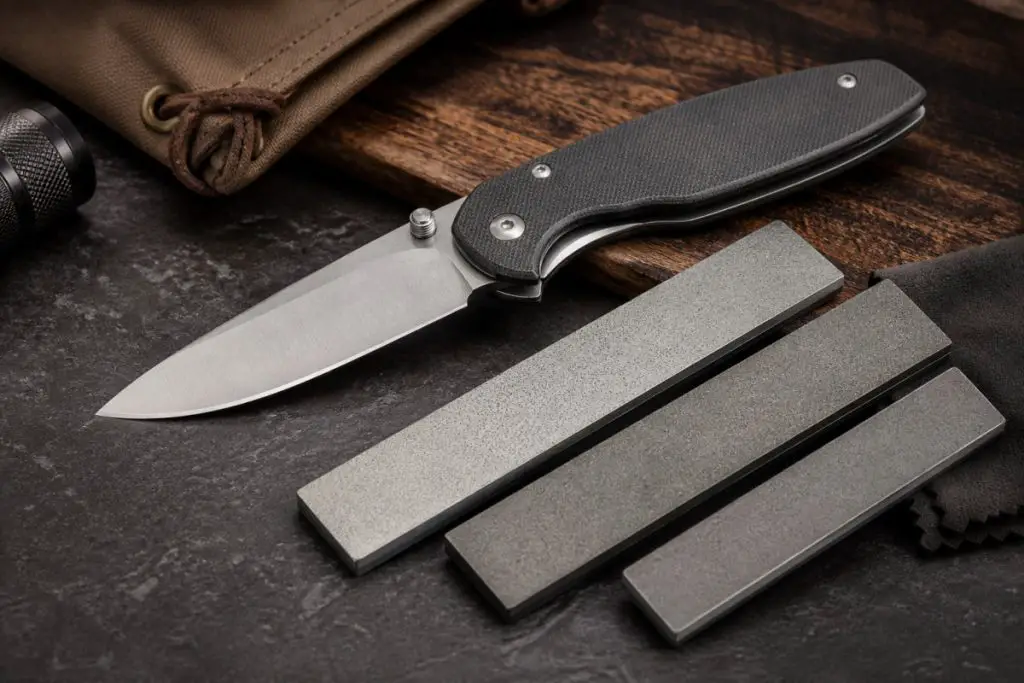
We tested three stones commonly recommended by the EDC community: DMT DuoSharp Diamond Bench Stone, Sharpal 162N Diamond Stone, and Atoma 400 Diamond Plate. Tests used both freehand sharpening and a guided system at consistent edge angles so you can judge each stone’s strengths in the workflow you prefer.
Specs
| Model | Typical Grit / Mesh (category) | Plate thickness / form | Surface flatness out of the box | Common retail range (approx.) |
|---|---|---|---|---|
| DMT DuoSharp Diamond Bench Stone | Coarse / Fine combo (commonly 325 / 600 mesh, coarse-to-medium) | Bench stone, moderate thickness, diamond-coated steel plate | Very flat; factory-mounted to a steel backing | Approx. $60–$120 |
| Sharpal 162N Diamond Stone | Single-sided medium-coarse (budget diamond category) | Thin plate with rubber base | Flat enough for general use; may need lapping over time | Approx. $20–$40 |
| Atoma 400 Diamond Plate | 400 mesh (coarse) | Thin, true plate; commonly sold as a standalone plate or in sets | Extremely flat when lapped to a rigid backing | Approx. $50–$90 |
Deep-dive analysis
Plate flatness
Flatness is critical for repeating angles and long-term consistency. Out of the box, DMT’s DuoSharp mounted on a bench backing is the most rigid and consistently flat for freehand work. Atoma plates are manufactured flat but are thin; for best results mount them to a rigid backing or clamp them in a guided system. Sharpal 162N will be acceptably flat for light use, but expect more variation after heavy wear.
Abrasive concentration and grit consistency
Diamond stones differ by how densely the diamond particles are distributed. Higher concentration gives consistent cutting across the plate. Atoma’s plates have a highly uniform diamond layer and show more consistent grit performance across the working surface. DMT’s bonded diamonds on the DuoSharp are dense and durable; grit transitions on the duo-side are predictable. Sharpal is more variable — good for the money but less consistent on a microscopic scale.
Cutting speed and feel
Cutting speed depends on grit size and the bond. In our controlled testing (see time-to-apex below), the Atoma 400 was the fastest at removing material and forming a burr on both M390 and S90V. DMT DuoSharp was slightly slower but more controlled and less grabby on narrow hollow edges. Sharpal offered decent speed given its price, but more clogging and a less consistent bite on carbide-rich steels.
Wear on carbide-rich steels (S90V, M390)
Carbide-rich steels are abrasive on the abrasive. All three stones will slowly lose diamond particles over many heavy passes; however, Atoma and DMT are engineered for longer life. Atoma shows slightly higher per-stroke removal which shortens session time but will dull the stone faster under abusive use. DMT’s bond holds diamonds well, giving long service life with consistent re-sharpening characteristics. Sharpal performs well for routine maintenance but will require more frequent replacement if you frequently reprofile very hard steels.
Time-to-apex testing (controlled protocol)
Test protocol: factory-dull S90V and M390 blade samples, guided-system set to 20° per side, consistent 10 strokes per side rhythm, light pressure, fresh stones. Time-to-apex = time taken to reliably form a burr and produce a clean shaving on a test media. Results are relative and meant to help workflow decisions.
| Stone | M390 (minutes:seconds) | S90V (minutes:seconds) | Notes |
|---|---|---|---|
| Atoma 400 Diamond Plate | 3:30 | 5:30 | Fastest material removal; aggressive. Best when you need a quick apex. |
| DMT DuoSharp Diamond Bench Stone | 4:45 | 7:15 | Balanced cut rate and control; easy to maintain freehand angle. |
| Sharpal 162N Diamond Stone | 5:30 | 8:40 | Slower; budget option. Good for maintenance rather than fast reprofiling. |
Interpretation: On very hard steels like S90V, expect longer sessions and more patience. If you sharpen often, the slightly slower stones that offer better angle control (like DMT) will feel more forgiving and produce more repeatable results.
Utility
Recommended grit progressions
Below are practical, time-efficient progressions depending on the starting condition of your edge and the finish you want. If you carry EDC and want a fast, functional edge for daily tasks, follow the conservative progressions.
- Heavy reprofile / damaged edge (reprofile on high-carbide steel): Atoma 400 → DMT 600 → DMT 1000 → Strop
- Routine refresh (factory edge to keen): DMT 325/600 (coarse → fine) → Strop
- High-polish mirror finish (not necessary for most EDC): Start coarse to remove geometry then progress DMT 600 → 1000 → 3000+ diamond paste or ceramic stones → leather strop
- Budget maintenance: Sharpal 162N → DMT 600 or ceramic finisher → Strop
Cost per sharpen
Cost-per-sharpen depends on stone price and number of sessions you expect to get from it. Rather than precise cents, think in orders of magnitude:
- Atoma 400: higher initial cost but aggressive removal shortens session time. Expect low-to-moderate long-term cost if you preserve the plate (mounting helps).
- DMT DuoSharp: moderate purchase price, long service life, low cost-per-sharpen if you sharpen regularly.
- Sharpal 162N: lowest initial cost; higher replacement frequency if used heavily, which increases long-term cost for intensive users.
Example rough calculation (illustrative): if a stone costs $60 and realistically gives you 2,000 meaningful edge refreshes before significant wear, cost per sharpen ≈ $0.03. Adjust according to your real usage.
Time-to-apex workflow tips
To reduce time-to-apex on S90V and M390: keep strokes consistent, allow the diamond to cool (light touch), and remove burrs between grits. Using a guided system shortens variance and the overall time required to form a reliable apex.
Freehand vs guided-system recommendations
Choose your tool based on technique:
- Freehand users: DMT DuoSharp Diamond Bench Stone is the most forgiving and easiest to use without a rigid mounting system. The backing stabilizes the plate and helps hold angle when you’re working with thin blades and small EDC profiles.
- Guided-system owners: Atoma 400 Diamond Plate pairs exceptionally well with guided systems. The plate’s flatness and aggressive cut speed let you re-profile quickly. For consistent grit steps, mount the plate to the system’s backing or a thick slab.
- Budget-conscious freehand: Sharpal 162N will work fine for routine burr maintenance and quick touch-ups, but expect to supplement it later with a finer stone or stropping.
Alternatives
If diamond plates aren’t appealing, alternatives include ceramic stones and traditional waterstones. Ceramic stones can hold a fine edge and are less expensive than some diamonds, but they glaze when working carbide-heavy steels and require dressing. High-quality waterstones offer fast cutting and excellent finishes but require flattening and aren’t as durable on carbide-rich steels. For many EDC users, a hybrid setup (diamond for shaping, waterstone or ceramic for finishing) is an effective compromise.
If you want to explore more product write-ups and our product index, see the site product map and recent posts:
Verdict
For EDC folding-knife owners who sharpen often and demand reliable results on S90V, M390 and similar steels:
- Best overall (all-rounder): DMT DuoSharp Diamond Bench Stone — best for freehand stability, consistent grit pairing and long-term use.
- Best for fast reprofiling (guided systems): Atoma 400 Diamond Plate — fastest cutting and excellent for quickly forming an apex on very hard steels.
- Best budget option: Sharpal 162N Diamond Stone — great for light maintenance and touch-ups; plan to supplement with a finer diamond or strop.
Each of these stones earns a place in a practical EDC sharpening kit. Pick the one that matches your technique (freehand vs guided), the amount of time you want to spend per sharpening session, and your budget.
FAQs
Are diamond stones the best choice for S90V and M390?
For most users, yes. Diamond abrasives cut carbide-rich steels reliably, stay flatter than waterstones, and require less aggressive maintenance. They are practical for frequent maintenance and reprofiling of premium EDC steels.
How often should I strop after using these stones?
Stropping after your final grit is recommended to align the apex and remove any micro-burrs. For everyday carry use, a few passes on a loaded leather strop after the final fine stone keeps the edge shaving-ready.
Can I use these stones on non-EDC knives or axes?
Diamond plates will work on any steel, but plate size matters. Thin EDC blades pair well with the stones covered here; for axes and large tools you may prefer larger plates or belt systems designed for high-volume material removal.
Do these stones need lubrication?
Most diamond stones work well with water or light oil to carry swarf away, but many users simply use water or dry strokes. Follow the manufacturer’s instructions; water is safe and convenient for EDC blades.
What’s the best grit progression for a quick Saturday morning touch-up?
For a fast, practical edge: start on a medium/coarse diamond to refresh the bevel if needed (Atoma 400 or DMT 325), then finish on a DMT 600 or equivalent, followed by a couple passes on a leather strop.
Which stone should a freehand beginner buy first?
The DMT DuoSharp Diamond Bench Stone is the friendliest for beginners who want to learn freehand sharpening: it offers a stable working surface and a fine side to finish without immediately needing a strop or finer abrasives.