
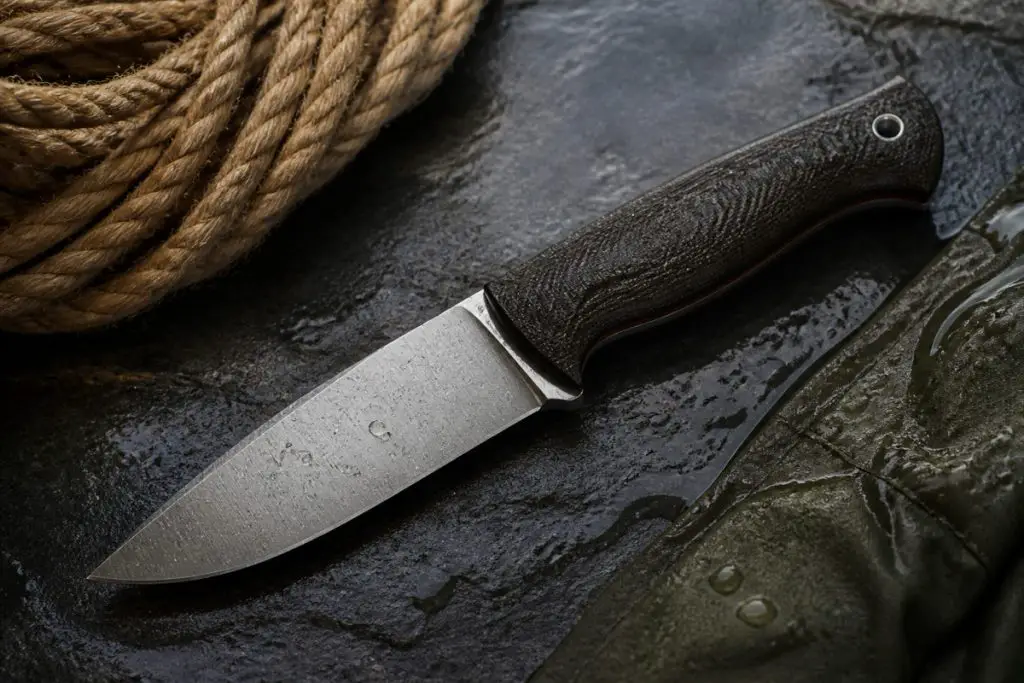

Best Fixed Blades for Wet-Weather Camping
The quick answer
For consistent performance in rain, salt spray and damp forests the top picks are:
- Morakniv Garberg Stainless — simple, stainless full-tang design with a comfortable polymer handle and easy-to-clean sheath.
- Spyderco Waterway — purpose-built for marine/wet use with highly corrosion-resistant metallurgy and a sheath designed for drainage.
- Gerber StrongArm — rugged 420-series stainless with a coated finish and a practical sheath, offering solid value in wet climates.
If you want a quick buying signal: the best fixed blade for wet weather will combine a corrosion-resistant blade alloy, low-corroding hardware, a sheath with drainage/airflow and a handle profile that stays grippy when wet.
Context
Wet-weather camping exposes knives to three main stressors: chemical corrosion from water and salt, mechanical wear from wet materials and grit, and microbiological hazards when you use the same tool for food after repeated soak-and-dry cycles. Survivalists in the Pacific Northwest, Scandinavia, the UK, northern Japan, Australia’s tropical north and coastal regions in the U.S. or Canada all face similar problems — though salt air near coasts accelerates corrosion more than inland rain.
Choosing the right tool means evaluating blade metallurgy, hardware materials (screws, fittings), handle materials for wet-grip security, and sheath construction for drainage and ventilation. In this review we score each candidate on those factors, separate hardware corrosion and sheath corrosion risks, and provide a practical care-time chart so you know how much maintenance a knife needs between trips.
Specs
Below are the relevant manufacturer-style specifications condensed for wet-weather comparison. Where a specific steel grade varies by variant we use the marketed material type (stainless / high-corrosion alloy).
| Model | Blade type & length | Marketed steel/material | Handle material | Sheath | Notes |
|---|---|---|---|---|---|
| Morakniv Garberg Stainless | Drop point, ~109–111 mm (4.3″) | Stainless-steel full tang (stainless variant) | Polymer/rubber overmold | Injection-molded polymer sheath with belt clip | Simple design, easy to disassemble for cleaning |
| Spyderco Waterway | Modified drop/wharncliffe profile, ~100–115 mm | Highly corrosion-resistant stainless alloy (marine-focused) | Textured polymer with ergonomic shaping | Drainage-optimized sheath, often moulded polymer | Designed specifically for wet/marine tasks |
| Gerber StrongArm | Drop point, 4.8″ (122 mm) | 420-series stainless (coated finish) | Glass-filled nylon over a rubberized grip | Injection-molded sheath with drainage and MOLLE | Military-style construction, aggressive grip |
Deep-dive analysis
Each knife below is scored across six categories important to wet-weather camping: blade corrosion resistance, hardware corrosion risk, sheath corrosion risk (retained water, trapped debris), wet-grip security, fire-prep suitability (batoning, feather-sticks after wet use), and food safety after repeated soak-and-dry cycles. Scores are out of 10; higher is better.
| Model | Blade corrosion | Hardware corrosion | Sheath corrosion risk | Wet-grip security | Fire prep | Food use after soak/dry |
|---|---|---|---|---|---|---|
| Morakniv Garberg Stainless | 8/10 | 8/10 | 8/10 | 9/10 | 7/10 | 8/10 |
| Spyderco Waterway | 9/10 | 9/10 | 9/10 | 8/10 | 8/10 | 9/10 |
| Gerber StrongArm | 7/10 | 6/10 | 7/10 | 9/10 | 9/10 | 7/10 |
How the scores were derived
– Blade corrosion: based on marketed steel family, surface finishes and typical resistance to pitting in fresh and salt water. Marine-focused alloys and factory-passivated stainless score higher.
– Hardware corrosion: looks at screws, pins and tang fasteners. Stainless hardware or sealed assembly scores well; exposed low-grade steel or plated hardware scores lower and needs more maintenance.
– Sheath corrosion risk: evaluates whether the sheath traps water, holds debris that retains moisture, or uses materials that degrade or rust (metal snaps, rivets). Moulded polymer sheaths with drainage are best.
– Wet-grip security: evaluated by handle texture, rubberized overmolds and ergonomic features that reduce slip when wet or soapy.
– Fire prep: considers ability to baton, make feather-sticks, strike a ferro rod when damp and maintain a working edge after wet use.
– Food use after repeated soak/dry: measures the blade’s ability to be cleaned and remain sanitary, and how surface finish affects food stickiness and bacterial risk following repeated wet/dry cycles.
Product notes and buy-or-skip guidance for rainy climates
Morakniv Garberg Stainless — Buy or Skip?
Buy for most rainy-climate survivalists. The Garberg Stainless is an excellent all-rounder: stainless blade, full-tang construction, a handle that stays secure when wet and a compact polymer sheath that doesn’t trap water. Hardware is typically stainless or low-contact, reducing corrosion risk. It is a particularly strong choice for campers in temperate rain belts such as the Pacific Northwest, the British Isles or New Zealand.
Buy-or-skip note: buy if you want low maintenance and a knife that’s easy to clean; skip only if you require a razor-edge steel that you plan to resharpen constantly in the field (some premium stainless alloys hold edge longer but can be harder to sharpen).
Spyderco Waterway — Buy or Skip?
Buy for salt-exposed or marine environments. The Waterway is purpose-built for wet and salt use: the blade metallurgy and sheath design minimize pitting and trapped moisture. Hardware and blocking features are selected to resist corrosion. If your trips include tides, fishing, or long coastal exposure in Australia, Scandinavia or Southeast Asia, this model is worth prioritizing.
Buy-or-skip note: buy if you need maximum corrosion resistance and a sheath that drains; skip if budget constraints force you to choose a cheaper alternative and you accept higher maintenance.
Gerber StrongArm — Buy or Skip?
Buy for rough work and batoning in wet forests. The StrongArm is rugged, has excellent ergonomics and performs well under mechanical stress; it is purpose-built for survival tasks like chopping and batoning. However, the coated 420-series stainless and some non-stainless hardware require more vigilance in salt-rich environments to avoid pitting or coating wear.
Buy-or-skip note: buy if you need toughness and comfortable wet grip for heavy tasks in inland rainy climates; skip if you will be repeatedly using the knife in salt spray without frequent post-trip maintenance.
Utility — practical wet-weather checklist
Use this checklist in camp to keep a wet-weather fixed blade operating safely and hygienically:
- Rinse saltwater and visible grit as soon as practical with fresh water.
- Open the sheath away from the body and let both knife and sheath air out for at least a few hours in a shaded, ventilated area.
- Wipe the edge and pivot/hardware dry with a clean cloth; apply a thin film of corrosion-inhibiting oil or silicone spray to metal surfaces before storing for long periods.
- Disassemble or partially disassemble (if the design allows) and inspect screws/pins for corrosion every few weeks during wet-season use.
- Use separate knives or thoroughly clean between wood/fire prep and food prep to reduce cross-contamination risks.
Care-time chart (recommended maintenance intervals after repeated soak-and-dry cycles)
| Condition | Immediate action (0–24 hours) | Short-term care (24–72 hours) | Routine maintenance (weekly during wet season) |
|---|---|---|---|
| Freshwater rain exposure | Shake off excess water, wipe blade and handle, open sheath to ventilate | Air dry for 24 hours; inspect for debris; light oil on metal surfaces | Sharpen/strop as needed; inspect screws and sheath seams |
| Saltwater splash or exposure | Rinse thoroughly with fresh water immediately; wipe dry | Soak in fresh water for a few minutes if heavily exposed, then dry and oil | Disassemble for inspection if possible; remove any compromised hardware and replace with stainless; re-oil |
| Repeated soak-and-dry cycles (multi-day trips) | Prioritize rinsing and wiping after heavy soaks | Rotate knives for different tasks; avoid food prep with a heavily soiled blade | Full cleaning: remove handle scales if possible, clean liners/hardware, re-lubricate |
Alternatives
If none of the three core models match your needs, consider these routes:
- H1 / LC200-series blades — many modern “salt-proof” knives use nitrogen-alloyed stainless steels marketed for marine use. These steel families are often top picks if absolute corrosion resistance is your priority.
- Fully synthetic hardware and polymer sheaths — some purpose-built water knives remove metal hardware where possible to prevent corrosion entirely.
- High-end stainless bushcraft blades — brands that use premium stainless alloys with excellent edge retention can reduce how often you must touch up the edge in the field, lowering maintenance time in wet seasons.
- Carbon steel if you prioritise ease of resharpening — only recommended if you accept regular maintenance and a reliable oiling regime to prevent rust during rainy season usage.
Be cautious of inexpensive coatings labelled as “rustproof” — coatings can fail with heavy use, and underlying substrate quality still matters.
Verdict
The best fixed blade for wet weather balances intrinsic corrosion resistance, low-corroding hardware, a drainage-friendly sheath and a handle that stays secure when wet. For a majority of outdoor survivalists across global wet climates:
- Best overall wet-weather performer: Spyderco Waterway — top choice where salt exposure is likely and corrosion resistance is the deciding factor.
- Best value and low maintenance: Morakniv Garberg Stainless — reliable, simple and great for temperate to rainy inland climates.
- Best for heavy-duty tasks in rain: Gerber StrongArm — built for hard use and excellent wet grip, but expect to maintain coated surfaces and hardware more frequently in salt air.
If you buy for rainy climates, prioritize a knife that also allows easy cleaning and periodic hardware inspection. Use the care-time chart above to match your maintenance commitment to the knife you choose.
FAQs
- Q: How often should I oil a stainless blade used daily in wet conditions?
- A: For stainless blades used daily in freshwater rain, a light oiling every few days is typically sufficient. If the knife sees saltwater, oil after every exposure and perform a deeper inspection weekly.
- Q: Can I use the same fixed blade for food preparation after working with wet wood and sap?
- A: Yes, but you should thoroughly clean and sanitize the blade before food prep. Rinse with fresh water, scrub with a mild detergent if available, dry, and then wipe with a clean cloth. If you lack cleaning supplies in the field, designate separate tools for wood/fire prep and food.
- Q: Is a coated steel better than inherently stainless steel in the rain?
- A: Coatings add corrosion resistance and reduce reflectivity, but coatings can wear or scratch away under heavy use, exposing the substrate. Inherently corrosion-resistant stainless alloys offer longer-term resilience with less dependency on surface treatments. Ideally choose both: corrosion-resistant steel with a quality finish.
- Q: What sheath features matter most for rainy camping?
- A: Drainage holes, minimal fabric layers that trap moisture, chemical-stable polymer material and no metal snaps or rivets that can corrode are the most important features. A sheath that allows airflow and is easy to clean prevents trapped moisture and mould.
- Q: Are there specific local considerations for wet-weather knives in coastal vs inland regions?
- A: Yes. Coastal and tidal areas expose knives to salt air and saltwater, which accelerate pitting and corrosion; prioritise the highest corrosion-resistant alloys and stainless hardware there. Inland rainy regions (temperate forests, mountains) still require corrosion resistance but the demands are lower; in those areas, toughness and edge-holding might take priority.
Further reading
Explore KnifePulse sitemaps and product indexes for more detailed posts and product pages: