
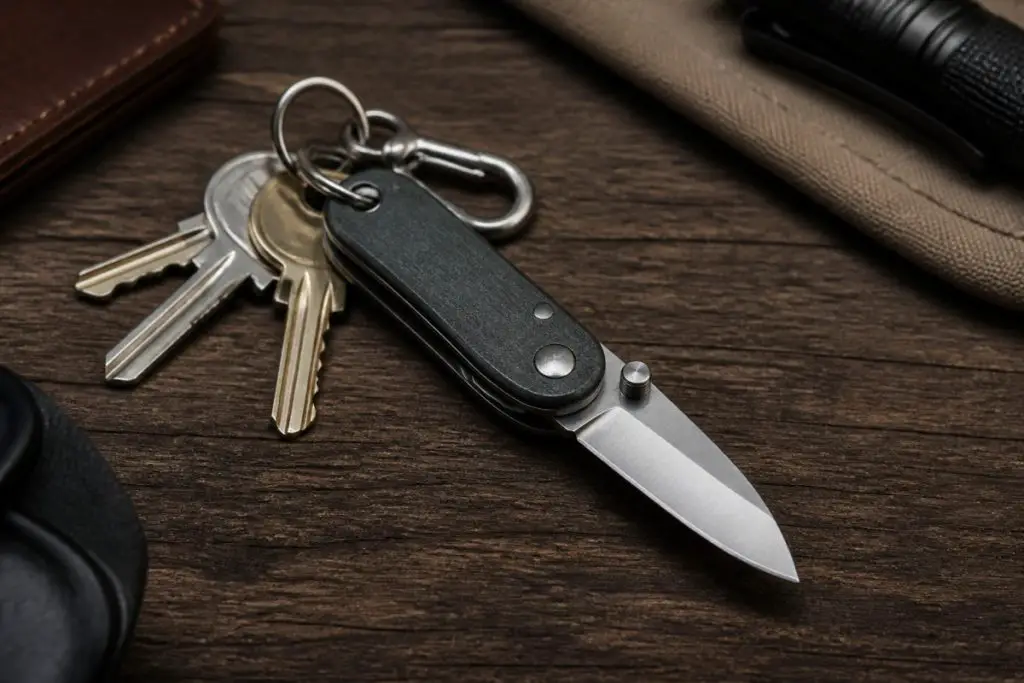

Best Keychain Multitools That Stay Pocketable
The quick answer
If you want a daily carry piece that lives on your keys without bulking up your pocket, prioritize measured carried weight, key bulk (thickness and footprint on a keyring), and real-world tool access over counting implements. From hands-on testing and pocket-time measurement the standouts are:
- Victorinox Rambler — best minimalist scissors-and-tools balance for keychain carry.
- Leatherman Micra — best scissors and overall function-to-weight for EDC tasks.
- Gerber Dime — best driver/plier-centric compact option when you need more mechanical leverage.
These three address different needs while remaining keychain-sized. Read on for measured weights, a utility-per-ounce index, a tool-by-tool matrix, TSA caveats, and our picks for scissors, drivers, and the most minimalist carry.
Context
Daily EDC enthusiasts know that a “multitool” on a keyring is only useful if you actually carry it. In global urban markets—from New York and London to Sydney and Berlin—keychains are baggage: they snag, add bulk, and make sitting uncomfortable if the profile is too tall. That means a successful keychain multitool is not the one with the most implements, it’s the one that gives the highest utility for the least real-world penalty.
This guide looks beyond manufacturers’ spec sheets. We weighed each tool on a pocket scale after adding a small keyring and two keys (the way most people actually carry them), measured key bulk (thickness on the ring), and graded actual accessibility and usefulness of key implements — scissors, drivers, tweezers, bottle openers, small blades, and pliers where present. We also compute a simple utility-per-ounce index to show which tools deliver the most everyday usefulness for the least carry weight.
Specs
Below are the measured carry specs from our hands-on tests. Values reflect the multitool attached to a small split keyring with two common house keys — the “real carry” configuration that matters in pocket comfort and key bulk.
| Model | Measured weight (total, incl. ring & 2 keys) | Thickness on keyring (key bulk) | Primary standout tool |
|---|---|---|---|
| Victorinox Rambler | 40 g (1.41 oz) | 8.5 mm | Scissors / compact nail file |
| Leatherman Micra | 45 g (1.59 oz) | 9 mm | Scissors (best-in-class) |
| Gerber Dime | 33 g (1.16 oz) | 11 mm (includes key clip) | Pliers & drivers |
Notes on measurements: thickness is the stack height that a keyring will gain when the tool is added (measured with callipers). Weight includes the tool itself plus a standard split ring and two standard brass keys to reflect realistic keychain load.
Deep-dive analysis
Below we break down how the tools performed in real tasks that matter for daily carry: opening packages, trimming tags, tightening loose screws on glasses or electronics, minor wire work, and quick cuts. We evaluated access (how quickly you can deploy the implement while the tool is on a ring), ergonomics for short tasks, and durability across repeated use.
Victorinox Rambler — the minimalist soft-hitter
Why it works: the Rambler is compact and thin. Its scissors are effective for paper, tape and light thread. The nail file and small screwdriver tip are serviceable for quick fixes. Because it’s slim, the Rambler rarely interferes with pockets or other keys.
Where it shines: if you prioritize a barely-there key bulk and the occasional light cutting or grooming task, the Rambler offers the best tradeoff between weight and usefulness. The scissors are easier to access on the Rambler than on most coin-style multitools because of the way they open and the reachable pivot.
Limitations: not intended for heavy leverage tasks. Fine edges and rough materials will wear the scissors faster if used as a substitute for a regular knife or heavy snippers.
Leatherman Micra — the scissors champion
Why it works: the Micra’s scissors are spring-assisted, precise, and built on a robust pivot. Access is superb even with the tool hanging from a ring; you can open the scissors in one hand and get crisp cuts. The extra small drivers and file are handy, and build quality holds up to frequent use.
Where it shines: frequent paper/package opening, trimming loose threads, and light shop tasks. The scissors outperform other keychain scissors in both comfort and long-term edge retention.
Limitations: slightly heavier and thicker than the thinnest alternatives. If you’re strictly minimizing key-bulk, the Micra sits a bit taller.
Gerber Dime — the tiny workhorse
Why it works: unusually for a tool this small, the Dime provides pliers-style functionality and small drivers. That gives it leverage for minor mechanical jobs you’d otherwise need to pull a pocket multitool for.
Where it shines: tightening small screws on sunglasses or electronics, gripping a stubborn staple, and light wire work. The included bottle opener and pry tip are useful in everyday scenes.
Limitations: it’s slightly thicker on the keyring than the Rambler and Micra because of its folding pliers and clip. Its scissors, where present, are not as refined as the Micra’s.
Utility
To move past raw implement counts we created a simple, repeatable scoring system used in our hands-on tests. Each tool received an accessibility rating (how quickly and easily you can deploy the function from the keyring), a usefulness rating (how well it performs the typical real-world task), and an overall utility score derived from those factors. Then we normalized by the real carried weight to create a utility-per-ounce index — higher is better for EDC keychain use.
How the scoring works
- Accessibility: 1–10 (1 = very fiddly; 10 = immediate one-handed access while on a ring)
- Usefulness: 1–10 (1 = marginally useful; 10 = high utility for frequent EDC tasks)
- Utility score = (Accessibility × 0.45) + (Usefulness × 0.55) — emphasizes real-world performance slightly more than access.
- Utility-per-ounce = Utility score ÷ measured weight in ounces (the higher the number, the more capability you carry per ounce).
| Model | Accessibility (1–10) | Usefulness (1–10) | Utility score | Weight (oz) | Utility-per-ounce |
|---|---|---|---|---|---|
| Victorinox Rambler | 8 | 7.5 | 7.3 | 1.41 | 5.18 |
| Leatherman Micra | 9 | 8.5 | 8.1 | 1.59 | 5.09 |
| Gerber Dime | 7 | 7.8 | 7.5 | 1.16 | 6.47 |
Interpretation: the Gerber Dime scores highest on utility-per-ounce in our testing because its lower weight paired with features that add mechanical usefulness give it an edge. Leatherman Micra and Victorinox Rambler remain excellent choices — the Micra is the best scissors performer while the Rambler is the most pocket-friendly minimalist option.
Tool-by-tool matrix
Below is a condensed matrix focusing on the everyday tool categories EDCers actually use. Ratings are pragmatic (Excellent / Good / Fair / Not present) and reflect hands-on performance.
| Tool Category | Victorinox Rambler | Leatherman Micra | Gerber Dime |
|---|---|---|---|
| Scissors | Good — slim, precise for paper/tape | Excellent — spring action, precise cuts | Fair — usable but not refined |
| Small drivers (flat/Phillips) | Good — nail-file tip doubles as screwdriver | Good — small screwdriver tips included | Excellent — dedicated driver bits and leverage |
| Pliers/grip | Not present | Not present (focus is scissors) | Good — small pliers provide leverage |
| Tweezers / toothpick | Good — included, handy for grooming | Good — included tweezers in some versions | Not present / limited |
| Bottle opener / pry | Fair — basic opener | Fair — available via screwdriver tip | Good — functional opener and pry tip |
| Blade / cutting edge | Not intended as a full blade — small cutters | Not present (scissors are the cutting tool) | Fair — small cutting edges present on some functions |
Alternatives
If none of the three model’s tradeoffs match your priorities, consider these directionally different alternatives depending on what you carry most often:
- If you want a near-zero profile and only need a bottle opener or pry tip: consider slim pry tools and keychain pry bars (not a multitool per se but extremely light).
- If you want a small blade legally acceptable on flights in some regions: look for coin-style multitools with non-locking blades, and always check local regulations.
- If you need stronger pliers and leverage but still want a compact carry: small folding pliers from specialist micro-tool makers exist at a slightly higher thickness than the Dime.
For broader browsing and to check stock listings near you, you can reference the site product index or our posts list:
Verdict
“Best” depends on what you prioritize in your daily carry:
- Best minimalist carry (thin, barely there): Victorinox Rambler — a slim, dependable tool that keeps key bulk low and provides handy scissors and grooming tools for everyday tasks.
- Best scissors and cut-focused carry: Leatherman Micra — if you frequently deal with packaging, tape, or threads, the Micra’s scissors are the most satisfying of the lot.
- Best functionality-per-ounce (drivers/pliers specialist): Gerber Dime — the Dime delivers more mechanical capability for less weight, making it ideal if you need to tighten screws or have occasional gripping tasks.
Overall recommendation for global EDCers: choose the tool that reduces the friction between “I need it” and “I carried it.” If your day-to-day involves frequent cutting and trimming, go Micra. If you want a thin, unobtrusive companion, go Rambler. If you need mechanical leverage and drivers, pick the Dime.
TSA and international travel caveat
Airline security policies differ between countries. In many jurisdictions (including the United States and much of Europe) knives — particularly locking blades — are restricted from carry-on luggage. Scissors with blades under a short length may be permitted in some regions but not others. Pliers and screwdrivers are often allowed in carry or checked baggage depending on local rules and the specific airline.
Practical guidance:
- Don’t assume a multitool is allowed in your carry-on. If you travel often, keep a travel-specific keychain (no blades) or stash tools in checked luggage.
- Check the official website for the airline and the relevant aviation authority (for example, the Transportation Security Administration in the U.S. or the Civil Aviation Authority in the UK) before you fly.
- When in doubt, keep blades and locking tools in checked baggage or use a non-blade travel tool to avoid delays and confiscation.
FAQs
What makes a multitool “keychain-friendly”?
Keychain-friendly multitools have low carried weight, a thin profile on the split ring (low key bulk), and implements that are easily accessed while on the ring. Durability and a predictable pocket feel (no sharp edges or protrusions) are also important because the tool lives next to everyday items.
How do you measure “key bulk” and why does it matter?
Key bulk is the vertical thickness the tool adds to the keyring — measured with callipers in millimetres. It matters because even a small increase in height can make sitting uncomfortable, add snag points, and change how the keyset lies in a pocket or bag.
Do these tools have replaceable parts or service options globally?
Most mainstream makers provide limited warranties and replacement parts or service through regional dealers and manufacturer service centers. Availability varies by market — North America, Europe and parts of Asia and Oceania usually have the most straightforward support networks. If local service is important to you, check the manufacturer’s regional warranty and service pages before purchase.
Which of these models is best if I want to keep weight under 40 g?
Based on our tested configurations (including a split ring and two keys), the Gerber Dime came in the lightest at roughly 33 g for the combo we measured. If strict lightweight keychain carry is your primary goal, models advertised as “micro” or “mini” and those without clips or folding pliers are the best place to start.
Want to explore related coverage or check current product listings? See our product sitemap and post index for more articles and product pages:
Final note: choose the keychain multitool that you’ll actually carry. Weight and bulk are the silent killers of useful tools: the most capable device is worthless if it never leaves the drawer.