
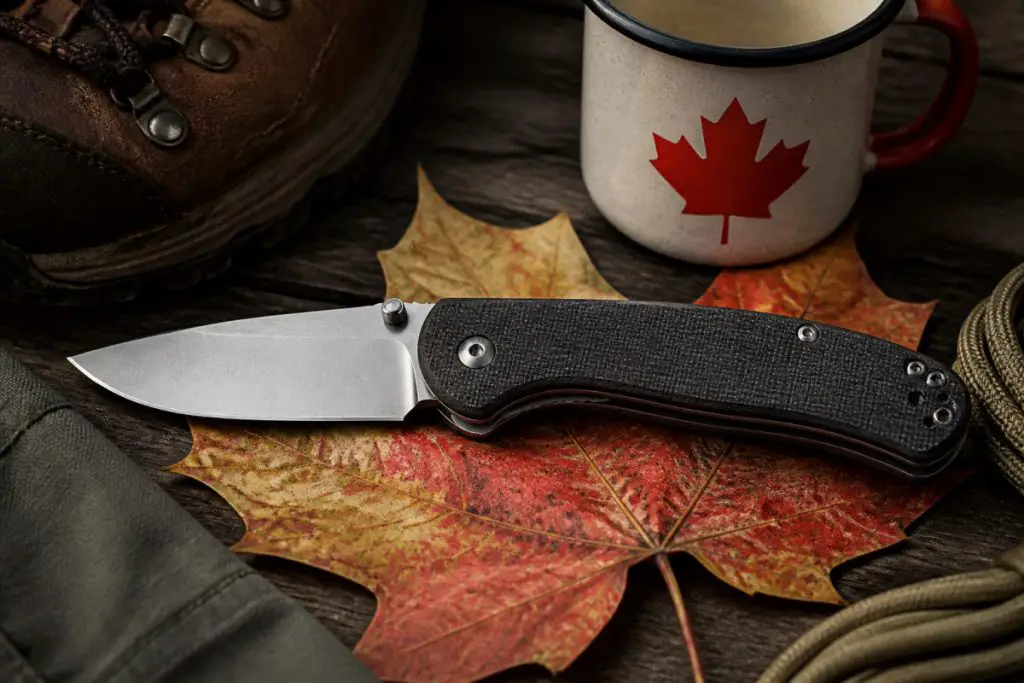

Can You Carry a Knife While Hiking in Canada?
The quick answer
Yes — you can generally carry a knife while hiking in Canada, but whether that carry is legal depends on design, opening mechanism, your intent, and where you are. There is no simple blade-length rule that makes a knife automatically legal or illegal. Criminal-law provisions and Canada Border Services Agency (CBSA) import rules focus on prohibited designs (for example, some automatic or gravity-opening knives and other specified types) and on whether a knife is carried for a dangerous purpose. Park, municipal and provincial rules can add further restrictions.
Context
Outdoor survivalists know a knife is a core tool: campsite chores, food prep, shelter work, cordage and first aid all rely on a dependable blade. But in Canada the legal picture is built around categories and context rather than a universal length threshold. Federal criminal law governs weapons offences and can turn on the intent behind carrying a knife; CBSA controls importation and border restrictions; and provincial, territorial and park authorities manage public-land access and safety rules.
That means the same EDC folding knife may be perfectly fine for day hikes in some areas, regulated in national parks, and scrutinized by officers if discovered during an encounter where intent is questioned. Understanding how design, opening mechanism, intent and location interact will help you make a lawful and sensible carry choice on the trail.
Specs — what matters to police, CBSA and park officers
The authorities typically look at a handful of factors when assessing whether a carried knife is lawful. Below is a concise table to help you understand which features attract attention and why.
| Feature | Why it matters | Practical notes for hikers |
|---|---|---|
| Design (type) | Some types (for example, automatically-opening knives, balisongs or other designs) are classified as prohibited for import or carry. | A manual-locking folder or fixed-blade in a sheath is least likely to be considered prohibited. |
| Opening mechanism | Automatic, gravity or spring-assisted mechanisms can trigger prohibitions or officer scrutiny. | Manual-opening blades — especially those with a reliable lock — are the clearest choice for lawful utility use. |
| Concealment & accessibility | Concealed carry where the blade is quickly accessible may impact whether police view the knife as for a dangerous purpose. | Store your knife in a pack sheath or in a secure sheath on your belt; avoid habitual “for-quick-access” carrying if intent could be questioned. |
| Intended use (intent) | Criminal-law analysis often turns on whether the knife was carried for a legitimate purpose (camp chores, survival) or a dangerous one. | Be able to articulate legitimate wilderness uses; carry other tools and evidence of a camping plan (map, permit, food) when possible. |
| Location | National parks, provincial parks, local bylaws and event spaces can restrict or prohibit knives beyond federal rules. | Check Parks Canada, provincial park pages and municipal bylaws for the area you’ll be hiking in. |
Deep-dive analysis
This section explains how the four core factors — design, opening mechanism, intent and location — interact in real life and in enforcement situations.
Design and prohibited categories
Federal authorities and CBSA pay special attention to particular knife designs. Certain knives are treated as prohibited or controlled for import and may attract seizure at the border. If you are crossing provincial or international borders, or buying online and having items shipped to Canada, CBSA rules matter.
For hikers, the practical takeaway is to prefer conventional, manually-operated folders or fixed blades with a sheath. Exotic designs (balisongs/“butterfly”, automatic opening or rapid-deployment blades) are more likely to be listed by CBSA or scrutinized by officers and could complicate carry even if you purport a legitimate purpose.
Opening mechanisms: automatic vs manual vs assisted
How a blade opens affects both importation and on-the-trail scrutiny. Automatic or gravity-opening mechanisms are the riskiest: they can be characterized as designed primarily for instant deployment, which can be a factor in prohibition lists or in establishing a dangerous purpose. Assisted-openers occupy a grey area — some are treated like manual folders in practice, others draw attention depending on the model and how they function.
Manual-opening folders with a positive lock are the simplest legal position because they clearly read as tools rather than weapons. Fixed blades in a properly secured sheath are also straightforward for utilitarian use at camp and on a route.
Intent — the fact pattern matters
Criminal law generally doesn’t only look at the object; it looks at why you had it. Officers assessing a carry may consider:
- What you were doing at the time (cooking, processing cordage, preparing shelter vs confronting someone).
- Whether the knife was being used legitimately (cutting food, gear repair) or brandished.
- Whether your behaviour suggested hostile intent (e.g., concealing the blade, making threats).
Practical defensive steps: carry evidence of your expedition plan (route, permits, group details), use your knife for clearly legitimate tasks in view of others where possible, and avoid walking around with a blade in hand unless you are actively using it for a valid trail purpose.
Location — parks, municipalities and private property
Parks Canada and provincial park systems have specific rules about behaviours that endanger others. Municipal bylaws can also regulate knives in public spaces (for example, events, streets). Even where federal law allows carry, a park warden may restrict or remove a knife if they judge it to pose a safety risk. Always check the specific rules for national parks (Parks Canada), provincial park systems (e.g., Ontario Parks, BC Parks, Alberta Parks) and any municipal bylaws for the trailhead town.
If you plan to hike in a national park, read the park’s regulations and contact the visitor centre if unsure. In some heavily used or sensitive areas — at trailheads near campsites, in children’s activity zones, or during staffed events —being more conservative about carry reduces conflict and risk of enforcement action.
Utility — how to carry sensibly on the trail
For outdoor survivalists the goal is to have the tool you need without creating legal risk. Consider these practical habits:
- Choose a manual-opening folder with a solid lock or a fixed-blade in a sheath. These demonstrate utility over aggression.
- Keep the knife sheathed or zipped in your pack when not in use. Rapid accessibility for life-saving work is fine; habitual “ready-in-hand” carry is more likely to be questioned.
- Use the knife for clear trail tasks in plain view: food prep, cordage, shelter, first aid. This documents legitimate purpose if asked.
- When transporting from home to trailhead in a vehicle, store the knife out of immediate reach (e.g., in luggage or a locked container) and avoid glove-box or console storage where it appears to be carried for possible quick use.
- If crossing provincial or international borders, check CBSA and foreign customs guidance before travel.
- Keep documentation of permits, plans, and group members on multi-day trips — it helps establish recreational intent if questioned by an officer.
Trail scenarios — what might happen and how to reduce problems
Scenario A — Day hike on a provincial trail: You carry a 3.5″ manual-locking folder in your pack. You stop for lunch and open it to cut fruit. This is a typical lawful usage pattern.
Scenario B — Backcountry overnight in a national park: You carry a fixed blade in a sheath, keep it in your pack while hiking, and use it at camp for food and tent work. Before entry you review Parks Canada rules; this is usually a defensible, practical carry choice.
Scenario C — Passing through a town or staffed trailhead: You walk through a crowded picnic area with an open blade in your hand. Even if the knife itself is legal, this behaviour risks police interaction and possible charges related to public endangerment or carrying for a dangerous purpose. Don’t do this.
Scenario D — Crossing the border with an automatic or restricted-style blade: CBSA officers may detain or seize prohibited items and could deny entry. Check CBSA import guidance before travel.
Alternatives
If you want to avoid legal complexity while retaining functionality, consider these alternatives and complements:
- Multi-tools with folding blades and shears — useful and generally viewed as tool-focused.
- Fixed-blade with a visible, securely-attached sheath — easy to show as a legitimate tool at camp.
- Small, manual-locking EDC folders rather than rapid-deploy or automatic blades.
- Non-cutting tools for specific tasks where a blade might be controversial (e.g., folding saws for wood, scissors for first aid).
- Bear spray and whistles for wildlife encounters (note: these are regulated and must be used per local laws and labelled use).
Verdict
So, can you carry a knife hiking in Canada? Yes — but lawfulness hinges on design, opening mechanism, intent and location. Avoid prohibited designs and automatic mechanisms, carry your blade in a way that demonstrates legitimate recreational use, respect park and municipal rules, and document your trip plans where practical. There is no single blade-length cutoff that guarantees legality; instead, make choices that emphasize utility, safety and transparency. When in doubt, choose the more conservative option: a manual folder or fixed blade in a secure sheath and keep it stowed until needed.
Not legal advice: This article explains practical considerations for outdoor survivalists and summarizes how Canadian law and CBSA practice commonly affect carrying knives. It is not legal advice. If you face enforcement or need a definitive legal interpretation, consult a qualified lawyer or the relevant authorities directly.
FAQs
1. Is there a blade length limit for carrying a knife while hiking in Canada?
No. There is no simple national blade-length rule that makes a knife legal or illegal. Enforcement focuses on design, opening mechanism, intent and location rather than a uniform length threshold.
2. Does the phrase “can you carry a knife hiking in Canada” mean I can take any EDC to the woods?
Not necessarily. While many everyday knives are suitable for hiking, certain designs (automatic openers, balisongs, and other restricted types) and carry circumstances can create legal exposure. Choose tool-oriented designs and avoid behaviors that suggest dangerous intent.
3. Are automatic or gravity knives illegal to import into Canada?
CBSA guidance lists certain knife types as prohibited or subject to seizure on import. Automatic and gravity-opening mechanisms are commonly flagged. If you plan to bring a knife into Canada, check CBSA rules before you travel or ship an item.
4. How should I transport a knife from home to trailhead?
Store the knife in a sheath or a locked container, place it in luggage or the trunk (or otherwise out of immediate reach), and avoid carrying it in a way that appears designed for quick deployment. This reduces the risk of an officer concluding it was carried for a dangerous purpose.
5. What if a park warden asks to inspect my gear?
Be cooperative, explain legitimate uses (camp chores, food prep, repairs) and present your knife stowed in its sheath. Know the park’s rules in advance — contacting the visitor centre before your trip can prevent misunderstandings.
6. Are there helpful Canada-specific resources?
Yes. For federal import and border policy check CBSA guidance, and for offences and legal standards consult the Criminal Code of Canada. For area-specific rules refer to Parks Canada and provincial park services (e.g., BC Parks, Ontario Parks). If you need to review our site index for gear or articles, see: https://knifepulse.com/post-type-post-sitemap-1.xml and https://knifepulse.com/archives-sitemap-1.xml.
7. What should I do if I’m questioned by police about my knife?
Stay calm, be respectful and answer truthfully. Explain the legitimate outdoor purpose for the knife and where it was stored. If you face charges or uncertainty about your rights, seek legal advice from a lawyer experienced in criminal or firearms/weapons law.
Final reminder for outdoor survivalists: a well-chosen tool carried responsibly keeps you prepared and reduces legal and interpersonal risk on the trail. Make decisions that prioritize safety, legitimate utility and compliance with local rules.