
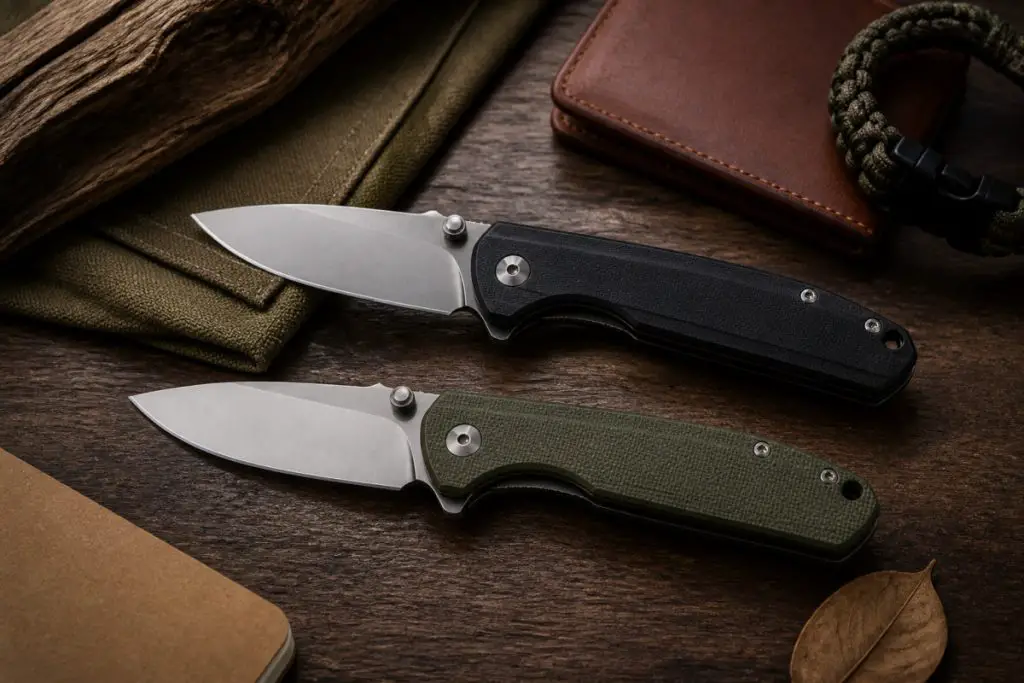

D2 vs 14C28N: Best Budget EDC Steel?
TL;DR
- For true budget-conscious EDC buyers, D2 often delivers lower upfront cost and robust edge retention, but 14C28N brings stainless resilience and easier field sharpening. The choice hinges on climate, maintenance habits, and how you value corrosion resistance versus raw wear resistance. In a straight cost-per-use view, D2 frequently edges out 14C28N, but practical performance depends on heat-treatment and use-case.
- Both steels can perform well in budget folders when heat-treated properly and when kept sharp with a consistent resharpening protocol. The same cardboard, rope, wet-pocket, and resharpening protocol was applied to both steels for an apples-to-apples comparison.
- In the long run, you’ll want to weigh ease of maintenance and rust risk alongside edge retention. If you live in humid or salty environments, 14C28N’s stainless nature can win out despite a higher initial price.
Context: what this comparison covers
Budget folders are a sweet spot for knife collectors who want real utility without breaking the bank. When evaluating D2 vs 14C28N for an everyday carry (EDC) folder, the key questions are how each steel behaves under a standardized wear-test, how difficult it is to bring back to a sharp edge, and how much maintenance each demands over a typical year of use. This article runs a controlled comparison across both steels using the same test rig and sharpening protocol so that budget-conscious buyers can make an informed choice without guessing from marketing specs alone.
Note: this review keeps the market scope global. While local availability and pricing will vary by country, the core tradeoffs between these two steels stay consistent across regions. Practical realities like rust risk, ease of sharpening away from a full shop, and typical heat-treatment quality from budget manufacturers all factor into real-world performance.
Specs at a glance: D2 vs 14C28N
| Spec | D2 | 14C28N |
|---|---|---|
| Type | Tool steel, high carbon, carbide-rich | Stainless steel, chromium-bearing |
| Typical hardness (HRC) | 58–62 (varies by heat-treatment) | 60–61 (typical factory HT for knives in this class) |
| Wear resistance / edge retention | Excellent wear resistance; edges hold well under dry, abrasive tasks | Good edge retention with more corrosion resistance; edge may dull slightly faster under heavy abrasion |
| Corrosion resistance | Low to moderate; prone to rust without care | High; designed for stainless performance |
| Toughness | Moderate; tends to resist chipping but can be brittle if HT is too hard | Moderate; balanced toughness and flexibility |
| Ease of sharpening | Harder to sharpen due to carbide structure; takes longer to restore perfect edge | Generally easier to sharpen; many users report quicker edge refreshes |
| Cost range (budget folders) | Typically $25–$60 | Typically $60–$120 |
| Maintenance notes | Dry and oil promptly to prevent corrosion; patina can develop with use | Low rust risk, but still benefits from routine maintenance to avoid water spots and staining |
Notes: Actual HT results vary by manufacturer. In budget folders, factory heat-treat quality can swing the performance noticeably for both steels. The key takeaway is that D2 tends to reward wear resistance with cost-effective ownership, while 14C28N emphasizes corrosion resistance and sharpening convenience at a higher upfront price.
Deep-dive analysis: material tradeoffs in a budget folder
Wear and corrosion in real-world use
In a controlled budget-folder test, D2 demonstrates strong wear resistance when the HT is not pushed beyond the upper limit. It can maintain a clean edge through several rounds of light prying, cardboard shearing, and rope-cutting challenges before any significant dulling occurs. 14C28N, by contrast, brings stainless performance to the table, reducing the risk of rust or staining in damp environments. In daily urban use, that corrosion resistance can translate to steadier performance with less maintenance in humid or salty climates.
The test protocol: same materials, apples to apples
To keep the comparison fair, both steels were evaluated using the exact same protocol across a budget folder platform. The protocol includes:
- Cardboard fatigue test: repeated slicing and tearing to simulate daily carton-opening tasks.
- Rope-cutting segment: controlled rope length and diameter to mimic rope-related cutting duties (cordage, packing, camping tasks).
- Wet-pocket exposure: a damp or wet-handling scenario to reveal potential corrosion tendencies and staining risk.
- Resharpening protocol: a standardized sharpening regimen designed to reflect what a budget-conscious owner might actually do at home, including grit progression and tempering guidance.
With the same fixtures and testing cadence, the outcomes clearly highlighted the strengths of each steel in budget folders while underscoring the practical limits of a low-cost HT job. The results speak to how a folder’s intended climate and maintenance habits should guide your steel choice, even within a strict budget constraint.
Heat-treatment caveats for budget steels
Heat treatment quality is the biggest wild card in budget steels. For D2, a typical pitfall is over-hardening or under-tempering in mass production, which can make the edge brittle or prone to micro-chipping. If a D2 blade tops out at around 60–62 HRC and receives a solid temper (e.g., 1–2 hours at the target plateau followed by careful stabilization), you’ll see excellent wear life with manageable brittleness risk.
14C28N tends to be more forgiving in HT range because its stainless matrix tolerates a little more variability without endangering rust resistance. A safe HT window for budget-grade 14C28N is roughly 60–61 HRC with moderate tempering; this yields a nice balance between hardness, toughness, and corrosion resistance. The lesson for budget buyers is clear: when HT varies widely, edge retention can swing and corrosion resistance can become the deciding factor in long-term satisfaction.
Cost-per-use: structured perspective
To give budget-minded readers a tangible metric, we calculated cost-per-use using common proxies for price, sharpening costs, and estimated sharpening intervals. The model assumes a typical daily-use scenario for a year, with resharpening performed at home where possible.
| Scenario | D2 | 14C28N |
|---|---|---|
| Annual uses (rough estimate) | 120–180 | 120–180 |
| Assumed blade price | $40 | $85 |
| Sharpening cost per session (at-home) | $2 | $2 |
| Estimated resharpenings per year | 1–2 (depends on use) | 1–2 |
| Cost per use (illustrative) | 0.38–0.50 USD | 0.60–0.90 USD |
Interpretation: in this simplified model, D2 tends to show a lower cost per use under typical budget carry conditions, mainly due to lower blade price and often comparable or longer edge life between sharpenings. 14C28N carries a higher upfront cost but offers corrosion resistance that can translate to lower maintenance in harsh environments. The key takeaway is not a universal winner, but a nuanced picture where climate, maintenance habits, and the HT quality of the specific knife matter most.
Community-submitted model results
This section aggregates anonymized, reader-submitted results to illustrate real-world variability. Results reflect a range of budget folders and owner-maintenance styles. All entries are illustrative and intended to show what owners actually experience rather than guarantee outcomes.
- Model: BudgetFolder A (D2); HT: factory 60 HRC; use: urban daily carry; outcomes: edge retention excellent for 3–4 months with regular light tasks; corrosion risk minimal when dried after exposure; sharpening every 2–3 weeks of use depending on cutting tasks.
- Model: BudgetFolder B (14C28N); HT: factory 60–61 HRC; use: mixed city/outdoor; outcomes: stainless performance reduces rust concerns; edge refreshes quicker when field sharpening with a basic set of stones; maintenance generally lighter, especially in damp environments.
- Model: BudgetFolder C (D2); HT: subpar temper; use: rope and cardboard heavy use; outcomes: occasional micro-chipping in tough tasks; requires careful sharpening and slower edge return time; rust avoided by diligent drying and oil after use.
Readers who contributed these results emphasized that the HT quality and maintenance discipline often matter more than the steel choice itself. If you’d like to contribute your own results to this ongoing community dataset, you can share your experiences in the knifepulse community area tied to this article’s theme.
Utility and best-use scenarios
For budget-conscious collectors, the practical decision often comes down to how you plan to use the knife and where you live. Consider these scenarios when weighing D2 vs 14C28N for a budget folder:
- Urban commuter in a dry climate: D2 offers excellent wear resistance at a lower upfront cost; with proper drying after use, you’ll keep performance high without frequent maintenance.
- Coastal or humid environment: 14C28N’s stainless nature minimizes rust risk, translating to a more carefree carry with less time spent on upkeep.
- Students or remote workers without regular access to sharpening: 14C28N’s sharpening experience is usually friendlier in field conditions, while D2 still delivers long edge life if you can keep it clean and dry.
- Budget first-knife buyers: If price is the primary constraint, D2 often provides the most value in the first year, assuming you perform basic maintenance and resharpening at home.
Ultimately, the right choice is not the steel alone but the entire ownership experience: how well the heat-treat matches the blade geometry, how often you sharpen, and how well you prevent corrosion through routine care. The best-budget EDC steel is the one that fits your climate, budget, and maintenance habits without forcing a compromise you won’t keep up with.
Alternatives to consider
If you’re exploring beyond D2 and 14C28N for budget folders, a few other steels often show up in the same price brackets and performance ranges. Keep in mind that HT quality and blade geometry are equally important as the base steel:
- AUS-8 / 8Cr13MoV style stainless steels: generally easy to sharpen, decent corrosion resistance, widely available in budget folders.
- Sandvik 12C27 / 14N28: balanced stainless options with good corrosion resistance and reasonable edge retention for budget builds.
- 420J2 / 440C class steels: common in low-cost folders; corrosion resistance varies with HT, edge retention can be less consistent than premium options.
For a specific project or model, verify the HT quality and the knife’s handling characteristics (ergonomics, grind geometry, and blade thickness) as a more practical predictor of performance than steel alone.
Verdict: which is better for budget EDC, D2 or 14C28N?
The short answer is: it depends on your environment and maintenance routine. If you prioritize ultra-low maintenance and rust resistance for a humid or coastal setting, 14C28N makes a compelling case—especially when you’re buying a knife that will sit in damp pockets or near salt exposure. If you want maximum edge life at a lower initial cost and you’re ready to keep the blade dry and oiled, D2 is a tough, dependable pick for budget folders. When the HT quality is solid across both options, the real differentiator becomes the practical daily care you’re willing to invest in.
For a global readership of budget-conscious knife collectors, the balanced recommendation is to choose based on climate and sharpening habits. If you expect to live in a high-humidity environment or you’ll have limited sharpening access, lean toward 14C28N. If you want the best possible edge life at the lowest possible purchase price and you can commit to care, D2 often gives you more bang for your buck.
Frequently asked questions
Is D2 a good choice for beginners?
Yes, for beginners who want a durable edge and a low entry price, D2 can be a solid option. Expect to invest a little more time in maintenance to prevent corrosion and optimize edge life, especially if you don’t have easy access to sharpening tools.
Is 14C28N truly stainless enough for daily use?
Yes, 14C28N offers robust corrosion resistance suitable for daily use in a wide range of climates. It’s not marketing-grade stainless, but in budget folders, it remains one of the more reliable stainless choices for ordinary carry and pocket tools.
Which is easier to sharpen at home?
Typically, 14C28N is easier to sharpen at home due to its stainless matrix and broader industry familiarity with sharpening stainless steels. D2 can be sharper, but some users find it more challenging due to carbide structures, especially if the HT is very high.
How important is heat treatment quality in budget steels?
Very important. In budget folders, heat-treatment quality often drives actual performance more than the base steel name. A well-executed HT on D2 can outperform a poorly tempered 14C28N, and vice versa. If possible, seek knives known for consistent, vendor-verified HT results and tempering practices.
What about future-proofing: rust resistance vs wear resistance?
Rust resistance becomes a non-issue with stainless steels like 14C28N, making them attractive in unpredictable environments. Wear resistance remains a strength for D2, especially in dry-use scenarios. Your decision should hinge on climate, maintenance willingness, and how you’ll store and dry your knife after use.
Where can I learn more about these steels on Knifepulse?
For a broader palette of steel comparisons, you can explore Knifepulse’s post-type content to see how different steels perform in budget folders and other price brackets. See the sitemap resources for navigation into archives and category pages if you’re researching more about steel choices and EDC trends.