
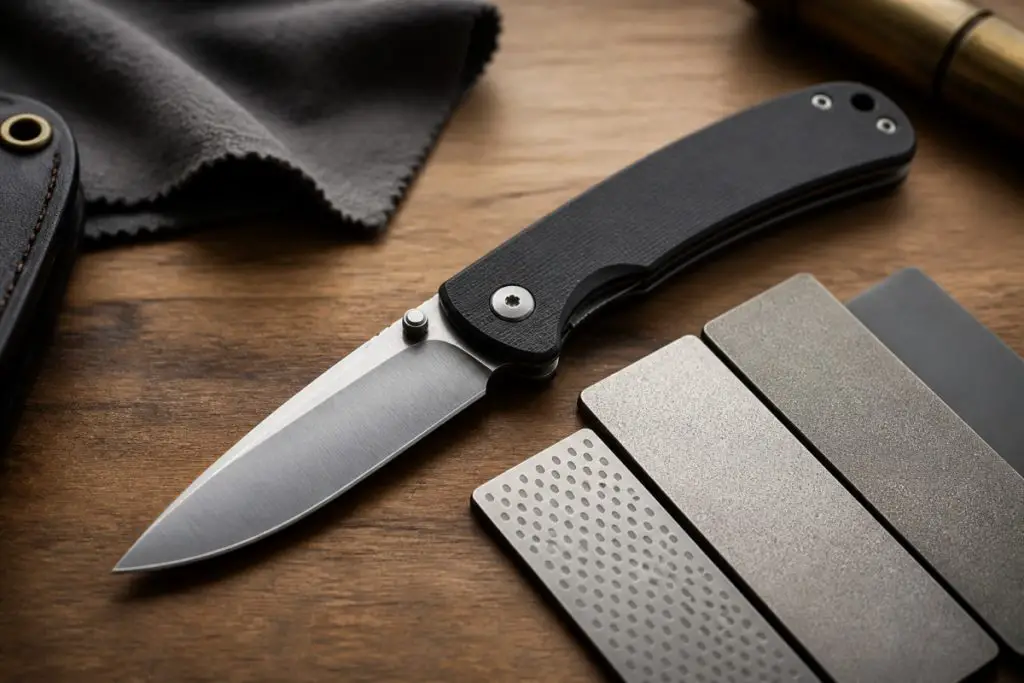

How to Sharpen S30V and M390 With Diamond Stones
Practical, step-by-step sharpening for daily EDC knives in wear-resistant steels. A guide for freehand and guided systems with time benchmarks and a printable checklist.
The quick answer
Diamond stones are the most efficient and predictable way to sharpen high wear-resistant steels like S30V and M390. Use a grit progression from coarse (for reprofiling) to medium (for bevel formation) to fine (for apexing), detect a burr on both sides, deburr carefully, then finish on a leather strop with an ultra-fine diamond or compound. For most EDC blades, a complete freehand sharpen using diamond stones takes 10–25 minutes; restoration/reprofiling can take 20–60 minutes depending on damage.
Context
EDC users choose steels like S30V and M390 for edge retention and corrosion resistance. Those same properties make them slower to sharpen than softer steels. Diamond stones cut consistently through the dense carbides in these PM (powder metallurgy) steels, so they’re the preferred abrasive for many owners. This guide covers a reliable workflow for both freehand and guided systems so your EDC is useful and safe in daily tasks.
Specs: what to use and why
- Stones: Diamond plates (ceramic or steel backing) that are flat and non-clogging. Choose coarse, medium and fine grits (see progression below).
- Grit progression: Common practical sequence – 325/400 (coarse) → 600–1000 (medium) → 2000–3000 (fine) → stropping (ultra-fine).
- Lubrication: Use water or light honing oil per the manufacturer. Many diamond stones work dry; a little water helps slurry removal.
- Angle control: 15°–20° per side (30°–40° inclusive) typical for EDC folders. Use a guided system if you need strict repeatability.
- Strop/compound: Leather strop with chromium oxide or diamond paste (0.5–1 µm) for these steels.
Note: This guide assumes safe handling and a steady work area. In cities across the US, UK, EU and Australia you can find diamond stones and strops at local knife shops and online retailers—search locally for availability and same-day pickup when needed.
Deep-dive analysis: step-by-step diamond-stone workflow
1. Prepare and inspect (2–5 minutes)
- Clean the blade and check for chips, roll or heavy damage.
- Secure your system: bench, clamp or guided jig. If freehand, position a non-slip mat and practice the angle on a scrap.
2. Coarse reprofiling (if needed) — 325/400 grit (10–30 minutes)
Use a coarse diamond only for reshaping or to remove chips. Keep consistent strokes, full-length of the bevel, and maintain the target angle. If the edge only needs minor refinement, skip coarse and start at medium.
3. Bevel establishment — 600–1000 grit (5–15 minutes)
Form the bevel on each side using controlled pressure. For a dull edge, 8–12 pulls per side with moderate pressure is a typical starting pattern; reduce pressure as you near the apex.
4. Apexing and refining — 2000–3000 grit (5–12 minutes)
Switch to a finer diamond to develop the micro-bevel and a keen apex. Use light, consistent strokes and feel for a burr.
5. Burr detection and removal (1–5 minutes)
Detect the burr by running the pad of your thumb gently perpendicular to the edge (not along it) or by using a fingernail. Deburr with alternating light strokes or single light pass at 90° to the stone followed by a few alternating light strokes on the fine stone.
6. Stropping (2–6 minutes)
Use a leather strop with a fine compound to polish the apex and remove any remaining wire edge. For S30V and M390, use a compound designed for high-hardness steels; perform light strokes with the spine leading to preserve the apex. A strop will significantly affect perceived sharpness even more than a final grit jump.
7. Testing and tuning (1–3 minutes)
Test the edge with paper, shaving a small section, or light push-cutting. If you find a catch, re-check the burr and touch the relevant side on the fine stone and strop.
Time-to-sharp benchmarks
| Situation | Workflow | Estimated time |
|---|---|---|
| Daily touch-up (mild roll) | 1000 → 3000 → strop | 3–8 minutes |
| Full sharpen (regular use) | 600 → 1000 → 3000 → strop | 10–25 minutes |
| Reprofile / chip repair | 325 → 600 → 1000 → 3000 → strop | 20–60 minutes |
Burr detection and what it tells you
The burr is a thin wire of metal formed when one bevel reaches the apex. If you can feel it along the entire edge, you have full bevel contact. If not, increase consistent strokes on the side that’s not producing a burr. When both sides have a burr, it’s usually time to move to the finer stone.
Apexing technique
For wear-resistant steels, light pressure and more strokes on the fine stones produce a better apex than heavy pressure. Micro-bevels of 0.5°–1.5° per side (on top of your working angle) help reduce chipping for EDC tasks. When using a guided system, reduce pressure as you refine the edge — guided jigs control angles, so the key is consistent stroke length and number.
Utility: real-world workflow for EDC users
Freehand workflow (compact field-ready)
- Secure the stone on a flat surface.
- Start at medium grit (600–1000) for a regular touch-up. Use consistent strokes, full bevel length, 6–12 passes per side.
- Check for a burr, then move to a fine stone (2000–3000) and repeat with lighter pressure.
- Deburr with alternating light strokes or a 90° pass on the stone. Strop for 30–60 seconds per side.
- Test on paper; repeat strop if needed.
Guided system workflow (bench-repeatable)
- Mount the knife and set target angle (usually 15°–20°).
- Use coarse only if reprofiling. Otherwise begin at 600/1000 and match stroke count on both sides.
- After burr confirmation, swap to 2000–3000. Keep stroke count and pressure consistent.
- Deburr and strop while the knife remains in the jig, if your strop can be safely operated with the jig attached.
- Finish with tuning passes on your preferred stone if required.
Downloadable checklist (print or save)
KnifePulse: Diamond-Stone Sharpening Checklist (S30V / M390)

Prep:
- Clean blade & stone area
- Secure knife (clamp/jig or firm freehand stance)
- Gather stones: 325/400 (optional), 600–1000, 2000–3000, leather strop + compound

Workflow:
- Reprofile with 325/400 if chips exist
- Form bevel on 600–1000; equal strokes per side
- Apex on 2000–3000; light pressure
- Detect burr on both sides
- Deburr with alternating strokes; 90° pass if needed
- Strop (chrome oxide or diamond paste)
- Test on paper; tune if necessary

Time estimates:
- Touch-up: 3–8 min
- Regular sharpen: 10–25 min
- Reprofile: 20–60 min

Notes:
- Keep stones flat and clean
- Reduce pressure as you go finer
- If guided, match stroke count rather than pressure
- Print this checklist or save as text for field use
Copy and paste the above checklist into a text file or print this page for a portable guide you can use at the bench or in the workshop.
Mistake diagrams (common errors and fixes)
Common mistake: Too steep an angle (overly blunt)
   Blade bevels: \ /
Alternatives
If diamond stones are not available, consider these options:
- ceramic stones (slower on PM steels but workable with patience),
- belt systems with appropriate belts (use very fine belts for final finishing),
- diamond hones or diamond-pastes on a flat plate for finishing small edges.
Diamond stones provide the fastest and most predictable cut on S30V and M390, but guided sharpeners and belts are legitimate alternatives depending on your setup, experience and time.
Verdict
For daily EDC owners who value repeatable, fast sharpening on wear-resistant steels, diamond stones are the recommended tool. A clear, consistent progression—coarse only when needed, medium to form the bevel, fine to apex, and a leather strop to finish—gives the best balance of edge retention and everyday cutting performance. Whether you use freehand technique or a guided system, follow the workflow, check for a burr on both sides, and finish with a proper strop for the keenest practical edge.
FAQs
Is it difficult to learn how to sharpen S30V with diamond stones?
Not necessarily. Diamond stones make the process faster and more forgiving because they cut consistently. Beginners should start with a simple angle (15°–20° per side), practice maintaining that angle, and follow the grit progression. Guided systems speed learning; freehand requires practice but gives flexibility for EDC knives with compound grinds.
How often will I need to sharpen an S30V or M390 EDC knife?
It depends on use. For light day-to-day tasks, a strop or quick 1000-grit touch-up every few weeks may suffice. Heavy use that cuts abrasive materials will require more frequent attention. These steels hold an edge longer than budget stainless steels but still need periodic maintenance.
Can I use the same stones for other steels?
Yes. Diamond stones are versatile and cut both soft and hard steels well. Keep them clean and flat. For softer steels, you may find ceramic or natural stones produce a different polishing character, but diamond plates are safe and effective across most knife steels.
Should I strop leather with compound or a bare strop?
For S30V and M390, a light compound (chromium oxide or diamond paste) on a leather strop produces noticeable improvement in cutting feel. A clean leather strop without compound can align the edge, but a compound will polish high-hardness steels more effectively.
What if I don't feel a burr — am I doing something wrong?
Not necessarily. Very thin burrs on high-hardness steels can be subtle. Use a fingernail perpendicular to the edge, or lightly run the heel of your thumb across the spine to detect the change. If in doubt, add a few more controlled strokes on the side that seems shy of forming the burr.