
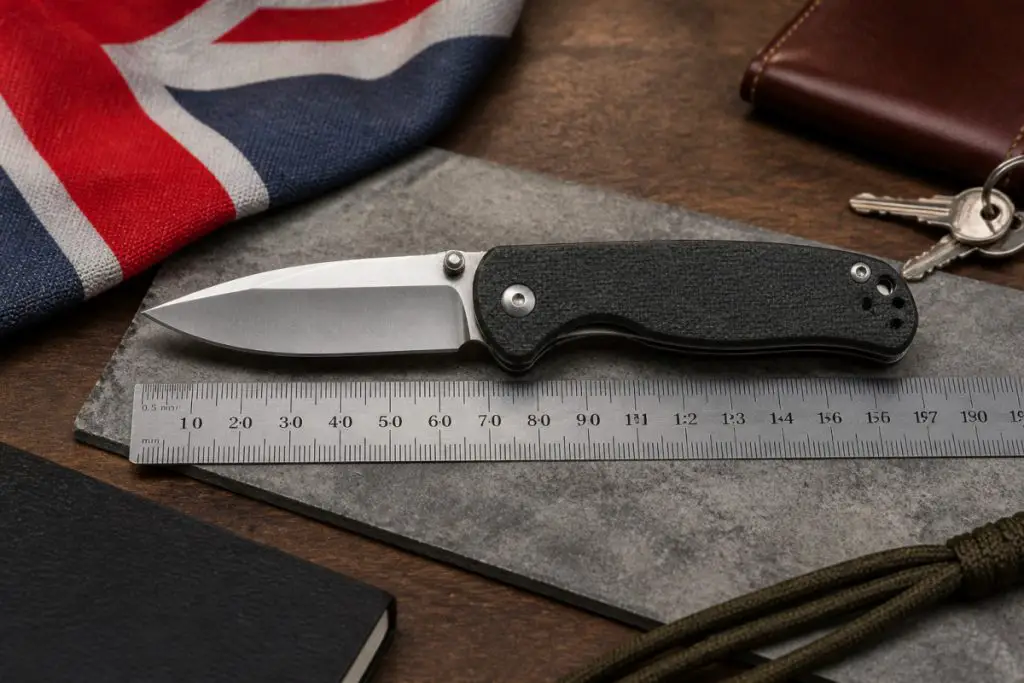

How UK Knife Blade Length Is Measured
The quick answer
In plain terms: blade length is usually taken as the metal blade portion that starts where the blade meets the handle and finishes at the tip. In everyday EDC measurement practice in the UK you’ll see three useful values: the cutting edge length (the sharpened edge you use), the blade length (full metal blade from handle junction to tip) and the overall length (blade plus handle). For legal and practical purposes you should also note whether a blade locks and whether there is a choil or curved edge — these affect how cutting edge and blade length are measured and how police may view the knife in public.
For readers searching “how is knife blade length measured UK” — authorities and common guidance measure both the blade and the cutting edge, and often consider locking mechanism separately. There is no single number that automatically makes a knife legal or illegal; context and intent matter.
Context
If you carry an EDC folder in the United Kingdom it’s important to understand what measurement terms mean and how officials typically interpret them. Knives are treated under criminal law as potentially offensive weapons in public places, so a clear, consistent measurement approach helps you stay informed and reduces risk when assessing an actual or theoretical legal boundary.
The UK market and enforcement landscape (England, Wales, Scotland and Northern Ireland) distinguish between:
- blades that lock open (locking folders and fixed blades), and
- non-locking folding knives and small penknives.
Police advice commonly mentions folding non-locking knives with a cutting edge under about 3 inches (≈7.6 cm) as an example that is less likely to lead to prosecution, but it’s not an absolute legal safe-harbour — officers and courts assess the full circumstances, including intent and location (schools, public transport hubs, courthouses, etc.). So knowing precisely how the blade and cutting edge are measured matters for both personal clarity and when explaining your EDC choice.
Specs — terms and definitions
Below are the standard definitions used by most EDC enthusiasts, measured toolmakers, and frequently relied on in practical policing situations. These are the terms you should know when measuring your knife or comparing specs.
| Term | Definition | How to measure |
|---|---|---|
| Cutting edge (edge length) | The sharpened portion of the blade used for cutting. | Measure along the sharpened edge from the start of the sharpened bevel to the tip; exclude unsharpened choils or sabre grinds. |
| Blade length | The full length of the metal blade from where the blade meets the handle (the blade shoulder or tang) to the tip. | Measure straight from the junction point (not the handle end) to the tip in a straight line. For curved blades use a centreline or chord method described lower down. |
| Handle length | Length of the handle from butt to where it meets the blade when closed or in its fitted position. | Measure along the handle; if the handle obscures the blade junction when closed, measure the exposed handle and add known pivot-to-shoulder dimension if available. |
| Overall length | Sum of blade length plus handle length (blade open). | With the blade fully open, measure tip-to-butt in a straight line. |
| Choil | A small unsharpened or intentionally recessed portion near the handle on the cutting edge. | Choils can reduce the measured cutting edge; note both raw blade length and cutting edge length when a choil is present. |
| Spine | Unsharpened top side of the blade opposite the cutting edge. | Not normally included in cutting-edge measurements but part of blade length. |
Deep-dive analysis: practical measurement techniques
The way you measure a knife depends on the blade geometry. Below are step-by-step approaches for the most common blade forms — straight, curved (clip or drop point), and blades with choils. Each approach aligns with how makers report specs and how UK enforcement typically interprets length.
Straight-edge blades
- Open the blade fully and lay it on a flat surface with the spine flush to the table.
- Identify the junction where the blade metal meets the handle tang (often visible as a shoulder or butt of the blade).
- Use a rigid ruler or calliper and measure from that shoulder in a straight line to the point of the tip — this is the blade length.
- For cutting edge, measure along the sharpened edge from the start of the bevel to the tip.
Curved blades (clip, drop, trailing point)
Curved cutting edges complicate edge-length measurement. The two practical methods are chord (straight-line) and arc (edge-following) measurement:
- Chord (straight-line) blade length: Measure as if the blade were straight — from blade shoulder to tip in a straight line. This is the usual “blade length” reported by manufacturers.
- Cutting-edge (arc) length: Measure along the centreline of the sharpened edge from its start to the tip. For long, highly recurved edges this gives a longer number than the chord length and is closer to functional cutting capability.
In everyday UK enforcement contexts, officers tend to focus on the blade length (shoulder-to-tip straight-line) and whether the knife locks; but the cutting edge length gives you a better sense of practical capability for EDC tasks.
Choils and ricassos
A choil is a small unsharpened gap between the handle and the start of the sharpened edge. A ricasso is an unsharpened flat area usually found on larger fixed blades. When you measure:
- Include the metal of the ricasso in the blade length (it’s part of the blade metal until the tip).
- Exclude a choil from the cutting-edge length if the choil is intentionally unsharpened; note both the full blade length and the usable cutting edge separately.
Illustrative diagrams
Below are simplified SVG diagrams showing the most common measurement points. These are scale-agnostic—they illustrate where to place the ruler.
The diagram shows the shoulder (blade start), the tip, and the cutting edge arc. In specs you will typically see the straight-line blade length reported; if the maker reports edge length they usually state it explicitly.
Utility — practical tips, printable ruler and measuring checklist
For daily EDC enthusiasts, accuracy matters when you buy, modify or compare folders. Use these practical tips and the printable ruler below.
Measuring checklist
- Always measure with the blade fully open and locked (if applicable) on a flat surface.
- Identify and note the blade shoulder/junction with the handle. If the shoulder is hidden, identify the pivot centre and subtract the known pivot-to-shoulder offset if you have it.
- Record both blade length and cutting edge length if a choil or ricasso is present.
- For curved blades, note whether you used chord (straight-line) or arc (edge-following) measurement.
- Document whether the blade locks open — locking blades are treated differently by enforcement than non-locking folders.
Printable ruler guide (print at 100%)
Use the SVG ruler below. Important: set your print dialog to 100% / actual size / no scaling and check the printed scale against a known ruler before relying on it. The ruler is 150 mm long and shows millimetre and centimetre marks to measure most EDC blades reliably.
Quick sanity checks after printing:
- Compare the printed ruler to a known metal ruler; if the numbers match, you can use it for quick measurement.
- If your blade is longer than the printable ruler, measure in two stages (tip-to-shoulder and shoulder-to-butt) and add the results.
Local UK tips
- When travelling through airport security (Heathrow, Gatwick, etc.) any blade is prohibited in hand luggage. Keep knives in checked baggage only and follow airline policies.
- In public transport contexts (e.g. London Underground) carrying a knife can attract immediate police attention — location matters.
- Certain places are legally restricted (schools, courts, sports grounds) and carrying any blade there is typically illegal regardless of length — always check local rules.
Alternatives — measuring tools and services
If you want more precision or independent verification:
- Use digital calipers for straight-line blade length (they give mm-level accuracy).
- For arc/edge lengths, a flexible measuring tape (sewing tape) wrapped along the edge gives practical cutting-edge length.
- Ask a reputable local maker or a knife shop to confirm measurements. For UK-based online catalogues, manufacturers will list both blade and edge length when relevant.
Want to explore more blades or compare exact specs? Check our product and content sitemaps for category and post listings:
Verdict
For EDC enthusiasts in the UK, measuring both blade length (shoulder-to-tip straight-line) and cutting edge length (sharp edge arc) is the sensible approach. Always note whether the blade locks and whether the cutting edge includes a choil — both influence how a knife is perceived and interpreted in a legal context. Use a proper ruler or calipers for accuracy, and if you rely on a printed ruler, confirm printing at 100% scale.
Remember: the question “how is knife blade length measured UK” is answered both technically (measure shoulder-to-tip and cutting edge) and practically (authorities consider locking mechanism, intent and location). Measuring accurately and documenting what you measured reduces ambiguity and helps you make safer, better-informed EDC choices.
FAQs
Q: Is there a legal blade length limit in the UK?
A: There is no simple, single statutory blade length that automatically makes a knife legal to carry in public. Common guidance references folding non-locking knives with a cutting edge of around 3 inches (≈7.6 cm) as examples less likely to lead to prosecution, but each stop-and-search or prosecution considers the full facts: intent, location, behaviour and the knife’s characteristics (including locking mechanism). Measuring clearly and knowing the facts about your knife is the best practical step.
Q: How do I measure a locking folder?
A: Measure blade length the same way — shoulder to tip in a straight line — and measure the cutting edge separately. However, note that locking mechanisms change how police and courts view a knife; a locking folder is typically treated more seriously than a non-locking slipjoint.
Q: Do I count the choil when measuring blade length?
A: Count the choil as part of the metal blade length (blade length includes the whole metal from shoulder to tip). For cutting-edge length, exclude any unsharpened choil and report both numbers when precision matters.
Q: What’s the difference between chord and arc measurement?
A: Chord (straight-line) measurement is the straight distance from the blade shoulder to the tip — it’s the usual “blade length” spec from makers. Arc measurement follows the sharpened edge and gives a longer figure for curved blades; it’s a practical measure of usable cutting edge.
Q: Where should I not carry a knife in the UK regardless of length?
A: Certain locations are effectively zero-tolerance: schools, certain sporting venues, court buildings and many public transport areas are legally sensitive places. Carrying any knife in those locations is likely to attract immediate action. When in doubt, leave it at home.