
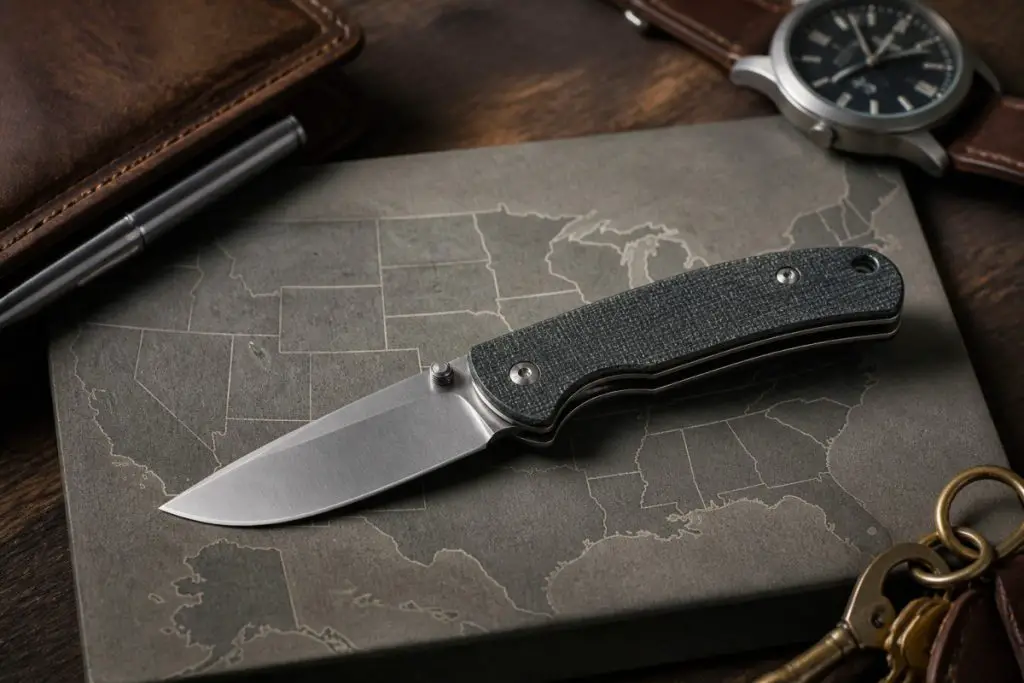

Knife Laws by State: 50-State Carry Guide
The quick answer
This site is the programmatic hub for detailed, state-level summaries of knife possession and carry rules across the United States. Use the interactive map and filter panel to find the current rules for concealed carry, blade length limits, automatic knives, state preemption and restricted places. Each state page shows an official citation, a last-verified date, a local-law warning, and a reader correction form you can use to report changes or clarifications.
The phrase “knife laws by state” describes the primary search intent this hub serves: quick, jurisdiction-specific answers for daily EDC gear enthusiasts who need to know what is allowed where they live and travel.
Context
Knife statutes in the United States are enacted at multiple levels: state legislatures set baseline criminal rules, and many states either preempt or allow local governments to add restrictions. County ordinances and city codes frequently create additional restrictions on carry or possession in public buildings, parks, transit systems and schools. That means a blade legal in a vehicle or on a sidewalk under state law may still be restricted by a municipal park rule or a county courthouse order.
For EDC users the practical takeaways are straightforward: know the state statute where you spend most of your time, check municipal codes for the cities you frequent, and keep copies or links to official citations and local enforcement guidance in your phone. When planning travel across state lines, review the destination state page and use the interactive filters to compare differences in automatic-knife rules and blade-length limits.
Specs
Each state entry in this hub follows a consistent, programmatic structure so you can compare jurisdictions quickly:
- Interactive summary block and quick status badge (Allowed / Restricted / Criminal) for common EDC scenarios.
- Filters for concealed carry, open carry (where relevant), maximum blade length, automatic/assisted-opening classification, and whether state preemption applies.
- Explicit “Restricted places” list (schools, courthouses, stadiums, transit, etc.) with common local exceptions.
- Official citation (statute or code section) displayed verbatim.
- Last-verified date noting when the page contents were checked against primary sources.
- Local-law warning: a clear reminder to confirm city/county rules and enforcement practices.
- Reader correction form link so visitors can submit updates or corrections.
The map supports filtering by:
- Concealed carry: permitted without permit / permitted with permit / prohibited.
- Blade length caps: none / specified maximum (e.g., 2.5″, 3″, 4″).
- Automatics: legal / restricted / prohibited.
- State preemption: full / partial / none.
- Restricted places: common mandatory ban locations displayed per state.
Deep-dive analysis
The body of knife law across the United States is shaped by several recurring themes. Understanding these patterns helps you interpret state pages and avoid surprises.
1. Preemption and local rules
Some states have express preemption clauses that stop cities and counties from enacting more restrictive knife laws than the state code allows. Others allow localities significant latitude. When preemption exists, you’ll see it noted in the filter and the state summary. Where preemption is absent, municipal ordinances often create patchwork rules—especially around schools, parks, transit and sporting venues.
2. Blade length and style definitions
A large share of state statutes regulate knives by blade length (measured in inches or centimeters) and by type—fixed blade, folding, switchblade/automatic, gravity knife, or dirk. The same numeric blade limit can be interpreted differently depending on whether the statute measures the full blade length or the exposed edge when folded, so the state page will clarify the statutory definition.
3. Automatics and assisted-openers
Automatic (switchblade) laws vary widely. Some states treat spring-assisted and manual folders as equivalent to automatics; others exempt assisted-openings if the user must push a thumb stud or apply manual force. The hub tags each state with its approach and gives verbatim statutory language where possible.
4. Intent and criminalization
Many statutes differentiate between mere possession and possession with criminal intent (e.g., carrying with intent to use unlawfully). That distinction affects whether a violation is misdemeanour-level, felony-level, or dependent on other conduct. Our state pages summarize typical enforcement thresholds and note where prosecutorial discretion or deference to local policy is common.
5. Places of restriction
State lists commonly ban knives in schools, courthouses, correctional facilities, controlled-access buildings, and sometimes in state parks or public transit vehicles. The hub lists both statutory bans and common municipal restrictions so travelers can check venue policies before entering.
Sample state summaries
Below are representative samples showing the exact fields you’ll find on every state page. These summaries are illustrative; consult the individual state page and the official citation for legal language.
| State | Carry / Limits | Automatics | Preemption | Official citation | Last-verified | Local-law warning | Reader correction |
|---|---|---|---|---|---|---|---|
| California | Concealed carry: restricted by type; blade-length limits for certain knives | Switchblades generally prohibited; assisted-openers evaluated case-by-case | Partial preemption — cities may impose additional location-based bans | California Penal Code § 17235 et seq. (see state code) | Last verified: 2026-08-15 | City ordinances (e.g., transit agencies, parks) commonly add restrictions | Submit correction |
| Texas | Strong state protections for carrying knives; many knives permitted | Automatics allowed under state law; local bans limited by preemption | Strong state preemption; municipalities have limited authority | Texas Penal Code Sec. 46.01 & 46.02 | Last verified: 2026-07-22 | Some venue-specific restrictions (airports, federal buildings) still apply | Submit correction |
| New York | Complex rules—certain gravity and switchblades prohibited; intent matters | Switchblades and gravity knives have specific prohibitions | Partial preemption; localities may have additional ordinances | New York Penal Law §§ 265.00–265.20 | Last verified: 2026-08-03 | Urban municipal enforcement can vary widely—check local PD policies | Submit correction |
Utility
How to use this hub for everyday carry decisions:
- Use the interactive map to select a state and toggle filters for concealed carry, blade length, automatics, preemption and restricted places. The map highlights states that match your selected criteria and links to the state-specific page.
- Read the quick summary badge for an at-a-glance status, then open the full page to see the verbatim official citation and the last-verified date.
- Before carrying in any public building, check the “restricted places” list for the state and verify local municipal ordinances for cities you will be in. If you’re traveling across municipal borders, check county and city codes too.
- If you find a discrepancy between our page and official sources, use the reader correction form linked on the state page or on the hub (submit corrections and attachments through the form).
For site navigation and content discovery, see our sitemaps if you want a programmatic view of all pages and posts:
Local SEO note: If you run a knife shop, knife training business, blog, or EDC accessory store, link to the applicable state page and include city-level pages that reference local law and enforcement resources (county clerk, city municipal code, state attorney general or state code repository). This improves both discoverability and user trust for local customers.
Alternatives
If you prefer other ways to check legal status before carrying, consider these options in addition to using this hub:
- Consult the official state code on the legislature or state judiciary website for the primary source text.
- Contact the local police non-emergency number or the county attorney’s office for clarifying policy questions.
- Review municipal code databases (many cities publish their codes online). Where available, search the municipal code for “weapons” or “dangerous instruments.”
- Legal help: for complex cross-border travel or specific criminal exposure concerns, consult a local attorney experienced in weapons law.
These alternatives are complementary. This hub is optimized for quick comparisons and alerts, but nothing replaces primary-source verification for legal planning.
Verdict
For everyday EDC enthusiasts who travel or commute, the Knife Laws by State hub is designed to be the first stop: a consistent, searchable, programmatic index of state rules with practical filters and plain-language summaries. Use the map for fast comparisons, check the official citation and last-verified date on the state page, and always heed the local-law warning: municipal restrictions and venue rules are common, and enforcement can be inconsistent.
Our goal is to reduce surprises and help responsible EDC users carry in compliance with the law. If you rely on this hub for decisions, bookmark the relevant state pages, keep the official citations available, and report any errors via the reader correction form to help keep pages current.
FAQs
Q: How often are state pages updated?
A: Each state page displays a “last-verified” date. We aim to review statutes and administrative guidance at least quarterly, and faster when legislatures are in session or major cases change the law. Visitors can submit updates or corrections using the reader correction form linked on each state page and the form sitemap: https://knifepulse.com/post-type-sureforms_form-sitemap-1.xml.
Q: Does a state allowance mean I can carry anywhere in that state?
A: No. State allowance addresses statutory permission or prohibition, but restricted places (schools, courthouses, transit, private property with posted bans) and local ordinances can still prohibit possession in specific locations. The hub lists common restricted places and flags where municipal rules commonly add further restrictions.
Q: Are assisted-opening knives treated as automatics?
A: Treatment varies by state. Some states explicitly include spring-assisted or gravity knives in automatic-knife prohibitions; others distinguish them. The state page will show the statutory language and our classification for assisted-openers in that jurisdiction.
Q: Can I rely on this site instead of a lawyer?
A: This hub is informational and not legal advice. For legal disputes, charges, or complex cross-jurisdictional travel questions, consult a licensed attorney in the relevant state. Use our pages as a research tool and cross-check with official statutes and local authorities when in doubt.
Q: How do I report a correction or new law?
A: Each state page has a reader correction form link. You can also submit corrections through our forms sitemap: https://knifepulse.com/post-type-sureforms_form-sitemap-1.xml. Include a link to the official source or a screenshot of the statute or ordinance when possible.