
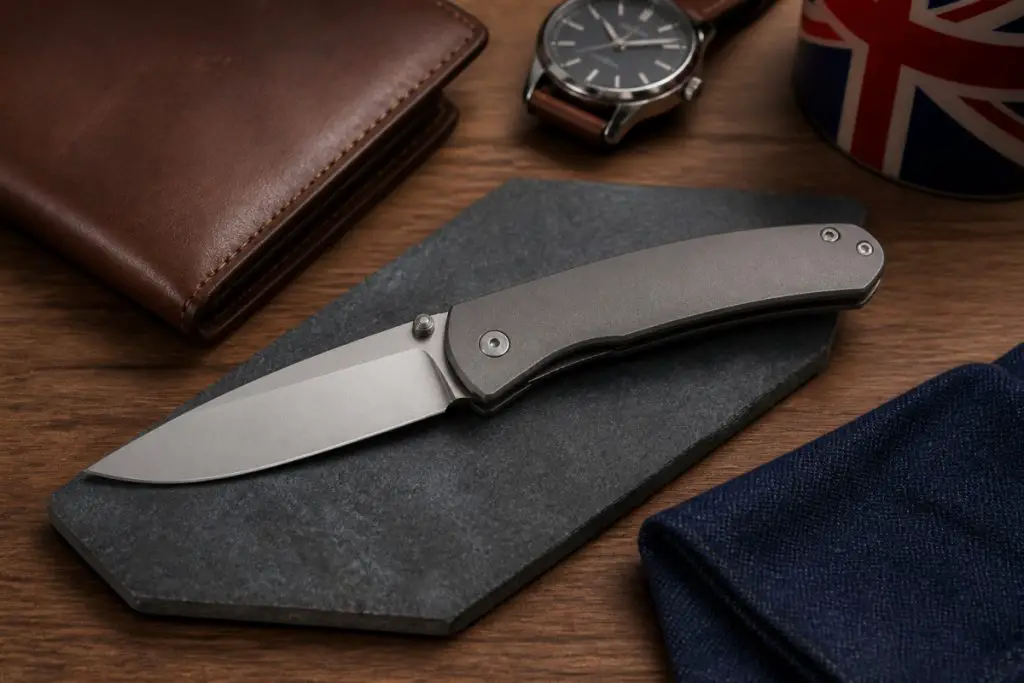

UK Knife Laws: What You Can Carry in 2026
The quick answer
Not legal advice: This article is for information only. If you need specific legal guidance, consult a solicitor or local police. The information below is current as of 2026 and links to official sources where you can check primary law.
Short version: for everyday carry (EDC) in the United Kingdom, a non-locking folding knife with a cutting edge of 3 inches (76 mm) or less is generally the safest option to carry in public without a specific “good reason.” Any locking blade, fixed blade, or knife with a blade longer than the 3-inch cutting edge may require a justifiable reason to possess in public. Possession and sale of certain designs (flick, gravity, disguised knives, etc.) are prohibited. Always check the exact law and local police guidance before carrying.
Context
Most EDC enthusiasts in the UK want a practical, legal everyday folder that does useful tasks without putting them at unnecessary legal risk. The UK approach to knife possession focuses on the combination of blade type, blade length (specifically the cutting edge), locking mechanism, and reason for carrying. Enforcement varies by police force and circumstances, and Scotland, Wales and England share broadly similar rules but with local differences in policing and court outcomes.
Authoritative online summaries are available from GOV.UK about buying and carrying knives: https://www.gov.uk/buying-carrying-knives. For primary legislation and statutory detail consult legislation.gov.uk (for example the Offensive Weapons Act and related provisions): https://www.legislation.gov.uk/ukpga/2019/17/contents.
Specs
Key points to keep front-of-mind when choosing an EDC for UK public carry:
- Legal-friendly mechanism: non-locking folding blade (slipjoint) is the lowest-risk option.
- Legal-friendly length: cutting edge no longer than 3 inches (76 mm) measured along the sharpened edge from tip to where the edge meets the handle.
- Design exclusions: automatic (flick) knives, gravity knives, disguised knives (e.g., comb or lipstick knives), and certain offensive weapons are banned designs.
- Places where knives are always illegal: schools and other education sites, courts, certain public events and transport hubs, and any premises with a specific ban (e.g., business premises with a no-weapons policy).
How to measure the cutting edge
Police and courts look at the cutting edge, not the whole blade length. Use the diagram below to measure the cutting edge accurately.
      Blade top (spine) ──────────────────────────┐
                                               |
                  /|         Tip                 |
                 / |                            |
                /  |                            |
               /   |                            |
      Handle ─┬┬┬┬┬┬┬┬┬┬┬┬┬┬┬┬┬┬┬┬┬┬┬┬┬┬┬┬┬┘
              └─┴┴┴┴┴┴┴┴┴┴┴┴┴┴┴┴┘
      Measure the cutting edge from tip to where the sharpened edge meets the handle
      3 inches = 76 mm (cutting edge)
Practical tip: measure along the sharpened edge with a ruler, and if in doubt keep it under 3 inches/76 mm.
Deep-dive analysis
This section examines real-world legal issues that EDC lovers encounter: what counts as a locking knife, how “good reason” is evaluated, the most commonly misunderstood bans, and how enforcement decisions are made.
Non-locking vs locking blades
A non-locking folding knife (slipjoint, friction folder, or traditional penknife) is a folder where the blade does not lock in the open position and can be closed by hand pressure on the blade. These are treated by police and courts as less dangerous in public because they require deliberate two-handed closing in many cases. Locking blades (liner locks, frame locks, button locks) are more likely to be viewed as “weapons” in public because they are considered more suitable for offensive use.
The 3-inch cutting-edge rule explained
Legally, the specific measurement police often use is the cutting edge. That means a long false edge or a long spine that is not sharpened can push total blade length beyond 3 inches without affecting the cutting-edge test, but presenting a long blade could still be interpreted as aggressive. The 3-inch rule is a helpful practical threshold, not a guaranteed “safe harbor.”
“Good reason” and common acceptable reasons
Having a “good reason” can make otherwise illegal possession lawful. Common examples historically accepted include:
- Work-related use (carrying tools on a worksite, with ID and employer confirmation).
- Religious reasons (e.g., kirpan for Sikhs) supported by evidence and context.
- Recreational purposes (fishing, camping) where the carrying is reasonable for the activity and location.
- Collecting or transporting to a repairer when the intention and route are sensible and provable.
Evidence helps: employer letters, event tickets, or equipment lists. Walking around an urban centre carrying a fixed blade to “camp later” without transport or proof is unlikely to be accepted.
Banned designs and what they mean for buyers
Designs that attract strict prohibition include:
- Automatic (switchblade/flick) knives and push-button opening mechanisms.
- Gravity knives and flick-style knives designed to open with inertia.
- Disguised knives – objects that hide a blade within an everyday item (e.g., comb, lipstick).
- Zombie knives and decorative blades marketed as offensive weapons (subject to specific statutory bans).
- Butterfly (balisong) knives are often illegal to possess in public, and buying/selling them can be risky.
The sale and import of some designs are restricted; check product descriptions and UK vendor policies before buying from abroad. The Offensive Weapons Act and related statutory instruments set out specific prohibitions—find the primary sources at legislation.gov.uk.
Restricted places you must never carry
Even a legal, small non-locking penknife can be banned in certain locations. Always assume higher restrictions in:
- Schools and colleges — zero-tolerance in many areas.
- Courts and secure government buildings.
- Airports, on-board aircraft, and certain passenger ferry terminals (security checks apply).
- Sports grounds, music festivals, and licensed premises where management or local bylaws disallow knives.
- Inside many workplaces — your employer can ban knives and take disciplinary action.
Utility
How to use this information as a daily EDC enthusiast based in the UK (practical, risk-reducing steps):
- Choose a non-locking folder with a cutting edge under 3 inches. Prefer traditional slipjoints from reputable UK or EU sellers.
- Keep proof of purchase and, where applicable, proof of your reason to carry (work ID, event ticket, camping permit) on your person.
- Use a modest, unobtrusive carry method — in a pocket, pouch or sheath — and don’t brandish your knife in public.
- Be mindful of local rules in Scotland, Wales and Northern Ireland as policing priorities and local policies differ.
- When in doubt, leave the knife at home or in locked transport to avoid confrontation with law enforcement.
Yes-or-no carry decision tree
Use this quick decision tree before heading out with a knife. This is a practical checklist, not legal advice.
    Start
      |
      +-- Do you have to carry a blade for work or an activity now? (Yes/No)
            |
            +-- Yes -> Can you show ID or documentation proving this reason? (Yes/No)
            |         |
            |         +-- Yes -> Choose a non-locking folder under 3" cutting edge when possible -> Carry
            |         |
            |         +-- No -> Consider leaving the knife or obtaining documentation -> Don't carry
            |
            +-- No -> Is the blade a non-locking folder with cutting edge  Are you going to a restricted place (school, airport, court, event)? (Yes/No)
                      |         |
                      |         +-- Yes -> Don't carry
                      |         |
                      |         +-- No -> Carry cautiously; be prepared to explain reason -> Carry (lower risk)
                      |
                      +-- No -> Don't carry (higher legal risk)
Alternatives
If carrying a knife feels risky or unnecessary for your daily routine, consider these practical alternatives that often meet the same utility without legal complication:
- Multi-tools with non-locking blades or tools where the blade is under 3 inches (check mechanism).
- Keychain tools and box cutters designed for legal utility (blunt-edged or with guarded blades).
- Specialised cutters or safety tools for work provided by employers (ask for a company-issued option).
- Carry a compact folding shears or scissors where legal — often acceptable for craft or hobby work.
When choosing alternatives, confirm they are allowed by local rules and employer policies. A small multi-tool may still be considered a knife if it has a locking blade.
Verdict
For UK EDC enthusiasts in 2026, the practical, risk-minimising choice is a non-locking folding knife with a cutting edge of no more than 3 inches (76 mm). Such a blade offers utility for everyday tasks while lowering the risk of arrest or seizure. Remember that “legal-looking” is not the same as legally safe: context, behaviour and reason matter. If you routinely need a larger blade for work or hobby, carry clear documentation and store it appropriately while travelling through public spaces.
Always check official guidance before buying or carrying a knife. Start with the GOV.UK page on buying and carrying knives and consult the legislation pages for the most authoritative text: https://www.gov.uk/buying-carrying-knives and https://www.legislation.gov.uk/ukpga/2019/17/contents.
FAQs
Is a 3-inch folding knife definitely legal to carry in the UK?
No single measurement guarantees legality. A non-locking folding knife with a cutting edge of 3 inches or less is generally considered the lowest-risk option for public carry, but police will also consider your behaviour, location and purpose. If you lack a “good reason” in a context where that matters, you could still face action.
Are locking knives illegal to own or carry?
Locking knives are not automatically illegal to own, but carrying a locking knife in public without a good reason increases the risk of arrest and prosecution. Many EDCers keep locking blades strictly for private property or work with documentation.
Can I carry a penknife on a flight within the UK?
No. Airport security prohibits knives on aircraft. Store any blade in checked baggage only if the airline and departure country rules allow; many low-cost carriers and airports have strict bans. Always check with the airline and airport before travel.
What counts as a ‘good reason’?
A good reason is situation-dependent and usually requires supporting evidence: for example a work ID or a ticket for an outdoor activity. Casual possession without evidence of purpose is less likely to be accepted by police or courts.
Where can I read the official rules?
Start with GOV.UK: https://www.gov.uk/buying-carrying-knives. For the primary legal text search legislation.gov.uk for the relevant Acts and statutory instruments: https://www.legislation.gov.uk/ukpga/2019/17/contents.
Local guidance and UK-specific tips
Policing practice differs across the UK. Urban centres such as London, Manchester and Glasgow have visible policing campaigns targeting knife crime — that can mean more stop-and-search activity. If you live in or travel to high-visibility policing areas, consider carrying less and being able to justify possession (work ID, equipment lists).
If you buy a knife from a UK retailer or a marketplace, keep the receipt and any product description showing blade length and mechanism. When buying from overseas sellers, beware of importing prohibited designs and pay attention to customs rules.
Useful official links
Internal resources
Further reading and site maps on KnifePulse:
- https://knifepulse.com/archives-sitemap-1.xml
- https://knifepulse.com/post-type-product-sitemap-1.xml
Change log
| Date | Change |
|---|---|
| 2019–2020 | Offensive Weapons Act introduced and clarified several bans on specific knife designs and increased sentencing options. |
| 2023 | Increased enforcement focus in several UK city centres and updated GOV.UK guidance pages; local policing priorities impacted stop-and-search emphasis. |
| 2026 | Article updated to reflect current guidance and to clarify measurement practice (cutting edge rule) and non-locking folder advice. |
Final reminder: This article summarises public guidance and common-sense carry principles for EDC enthusiasts in the UK. It does not replace legal advice. Laws change and policing practices vary—always verify the current statutory position and local guidance before deciding to carry any blade in public.