
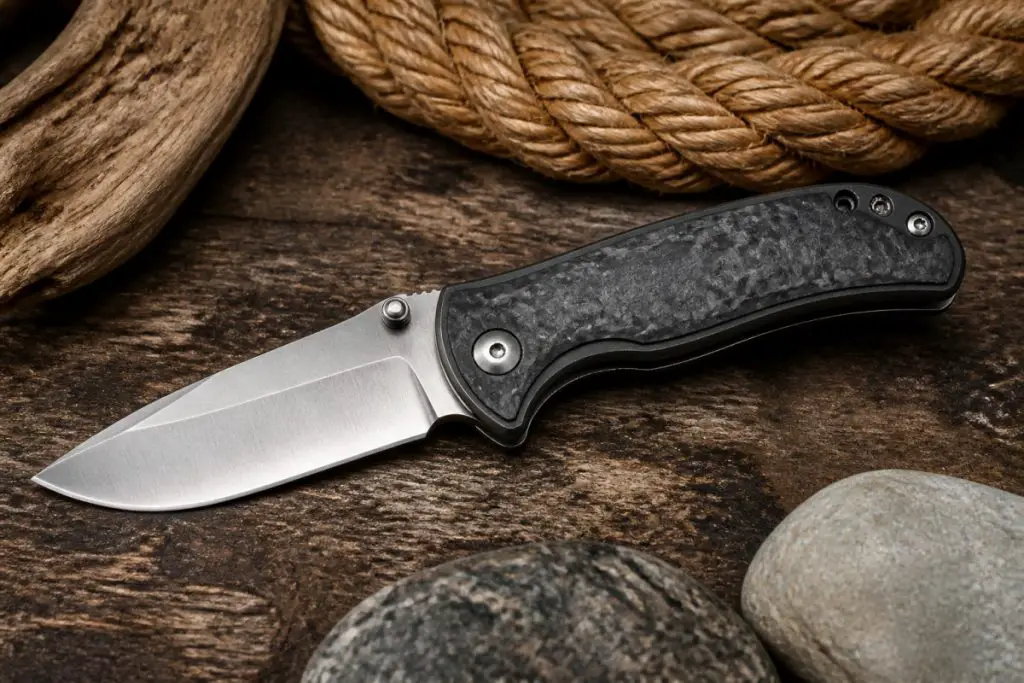

LC200N vs MagnaCut vs Vanax for Saltwater
The quick answer
For coastal carry and frequent saltwater exposure, LC200N is the safest choice if your primary concern is corrosion resistance and low maintenance. MagnaCut balances corrosion resistance with superior edge retention and toughness, making it the best overall compromise for demanding marine environments. Vanax brings excellent wear resistance and toughness but typically requires more attention to hardware and coatings to avoid galvanic and attachment-point corrosion. In short: LC200N for lowest maintenance, MagnaCut for balanced performance, Vanax for maximum wear resistance when paired with corrosion-proof hardware.
Context
Outdoor survivalists who live, work, or recreate on coasts—from Florida and California to the Mediterranean, Caribbean, Australia and Southeast Asia—need knives that stand up to salt spray, humidity, and occasional immersion. Steel chemistry matters, but so do heat treat, blade geometry, coatings, and hardware materials (pivots, liners, screws). This guide compares the three steels specifically for saltwater carry across five practical axes: corrosion resistance, attainable hardness, toughness, edge stability, and sharpening difficulty. It separates intrinsic steel behavior from common hardware and handle corrosion issues and includes a decision matrix, rinse-frequency guide, and real-world model examples for common carry setups.
Specs (what to expect in production knives)
Below are pragmatic, real-world specs you’ll see in production and custom knives using these steels. Exact numbers vary by maker and heat treat; treat these as typical ranges and characteristics rather than guarantees.
| Characteristic | LC200N | MagnaCut | Vanax (generalized) |
|---|---|---|---|
| Chromium / stainless behavior | Very high corrosion resistance (N-enhanced stainless); lowest maintenance | High corrosion resistance (powder stainless); excellent in marine use | High corrosion resistance (vanadium-rich stainless powders); good but can vary |
| Common factory hardness | Typically moderate — often heat-treated for toughness over extreme hardness | Typically higher — makers often push for excellent edge retention | Often heat-treated to high hardness for wear resistance |
| Toughness | Good toughness; forgiving for user abuse | Very good toughness for a high-performance stainless | Very good to excellent toughness, depending on heat treat |
| Edge retention | Moderate — easier to re-sharpen but needs more frequent touch-ups | Excellent — long-lasting edges in typical marine cutting tasks | Very good to excellent wear resistance |
| Sharpening difficulty | Easy to moderate | Moderate — demands good carbide stones or diamond abrasives for best results | Moderate to challenging (vanadium carbides) |
Deep-dive analysis
Below I compare LC200N vs MagnaCut vs Vanax along the five decision metrics survivalists use in marine environments. This section focuses on intrinsic steel behavior; hardware corrosion and handle materials are discussed separately after the steel analysis.
1. Corrosion resistance
– LC200N: Designed as a highly corrosion-resistant stainless alloy (nitrogen-enhanced). It is the least likely to show active rust or pitting from saltwater contact and can tolerate infrequent rinses better than most high-performance steels. For low-maintenance coastal carry, LC200N is the standout.
– MagnaCut: A modern stainless powder metallurgy steel that combines high chromium and tailored alloy elements for excellent corrosion resistance. It resists pitting strongly and performs nearly as well as LC200N in many tests, though specific heat treats and surface finish matter.
– Vanax: Developed for wear resistance and toughness with good stainless character. Its chloride resistance is generally strong, but performance can vary with heat treat and surface condition; unlike LC200N, granular differences in finishing and edges can influence visible staining.
2. Attainable hardness
– LC200N: Manufacturers tend to keep LC200N in a moderate hardness window to preserve toughness and corrosion performance. That means slightly less absolute edge-life than the hardest powder steels but easier maintenance in the field.
– MagnaCut: Frequently run at higher HRC values in production knives to maximize edge life without compromising toughness—this makes MagnaCut a top pick where long-lasting edges are critical.
– Vanax: Typically used at medium-to-high hardness to leverage its wear resistance. Expect good edge life but a potentially tougher sharpening session in the field.
3. Toughness
– LC200N: Good impact and fracture resistance; forgiving in heavy use. If your work involves prying, batonning, or hard field use, LC200N’s slightly lower hardness choices can be an advantage.
– MagnaCut: Designed to balance wear resistance with toughness. It holds a fine edge while resisting chipping under typical outdoor tasks.
– Vanax: High toughness potential when heat-treated for it—suitable for hard-use blades, especially fixed blades. Vanax variants are often preferred where a hard-wearing edge is required without brittleness.
4. Edge stability (real-world edge life)
– LC200N: Moderate edge life. For survivalists cutting rope, fish line, or fibrous materials, expect to re-profile more often than with MagnaCut or Vanax.
– MagnaCut: Excellent edge stability across wet and dry materials, making it a top choice for long days on a boat or repetitive cutting tasks.
– Vanax: Very good edge stability due to vanadium carbides; excels against abrasive materials but depends on geometry.
5. Sharpening difficulty in the field
– LC200N: The easiest to re-sharpen with basic stones and strops; good for survivalists relying on simple sharpening kits.
– MagnaCut: Requires sharper stones and a bit more time to restore factory edges, but still approachable with diamond stones or higher-grit ceramic stones.
– Vanax: Can be more demanding due to hard carbides; diamond stones or powered systems make restoration faster.
Hardware and handle corrosion — separate but crucial
No matter how corrosion-resistant the blade steel, pivot collars, liners, screws, backspacers, and pocket clips can corrode in saltwater environments. Separate the blade material decision from hardware choices:
- Prefer titanium, G10, or ceramic bearings and stainless fasteners rated for marine use (A4/316 stainless) where possible.
- A highly corrosion-resistant blade on top of poor hardware will still result in a knife that seizes or stains around the pivot.
- Look for sealed pivots, phosphor bronze washers that are corrosion-resistant, or blade coatings that protect contact points.
Marine-use decision matrix
Use the matrix below to match priorities to the right steel for saltwater carry.
| Priority | LC200N | MagnaCut | Vanax |
|---|---|---|---|
| Lowest maintenance / minimal rinsing | Best | Very good | Good |
| Edge longevity during long outings | Fair | Best | Very good |
| Heavy-duty/prying/tough tasks | Very good | Very good | Best |
| Ease of field sharpening | Best | Good | Fair |
| Overall marine carry recommendation | Top pick for low-maintenance carry | Best overall performance compromise | Top pick when wear resistance is the priority |
Rinse-frequency guide (practical for on-boat and shoreline use)
Rinsing and drying are the most effective ways to keep any blade serviceable. Below is a simple guide tailored to saltwater exposure levels.
| Exposure level | Recommended rinse frequency | Notes |
|---|---|---|
| Direct immersion (dropped in seawater / used while submerged) | Rinse immediately with fresh water; dry and oil same day | Remove and inspect hardware; lubricate pivot with corrosion inhibitor |
| Heavy salt spray (offshore fishing, surf work) | Rinse daily after use; full inspection every 48 hours | Quick wipe between uses if fresh water is unavailable |
| Light exposure (coastal EDC, occasional spray) | Rinse weekly or after heavy sessions; wipe and oil after drying | LC200N can tolerate longer intervals, but hardware still needs attention |
| Storage between trips | Clean and fully dry before storing; apply thin oil coat | Use silica or desiccant in a sealed box for humid climates |
Model examples and carry setups
Below are practical, real-world model examples to illustrate how each steel is typically applied in saltwater-capable builds. These are representative setups rather than brand endorsements.
-
Low-maintenance EDC folder — LC200N
- Blade: LC200N drop-point, 3–3.5″ length
- Hardware: Titanium backspacer, 316 stainless screws, sealed pivot or phosphor bronze washers
- Handle: G10 or FRN for non-metal contact
- Why: Minimal daily corrosion risk; easy field sharpening
-
All-around marine workknife — MagnaCut
- Blade: MagnaCut tanto or modified drop with convex grind
- Hardware: 316 stainless or titanium fasteners, sealed pivot bearings
- Handle: Textured titanium or coated stainless with G10 inlays
- Why: Long edge life for cutting line and chafing-resistant tasks while maintaining strong corrosion resistance
-
Heavy fixed blade / abrasive-use tool — Vanax
- Blade: Vanax full-tang bushcraft/fish-processing blade, thicker stock
- Hardware: Integral construction or fully stainless rivets; sheath made from Kydex or closed-cell foam
- Handle: Micarta, G10, or synthetic that resists water absorption
- Why: Max wear resistance for repetitive filleting, scraping, or cutting abrasive rope and haloed debris
Utility — how this affects what you actually do in the field
Practical decisions are shaped by how you use the knife:
- If you’re an offshore angler or commercial fisherman who can’t stop and service gear often, LC200N reduces daily maintenance and lowers the risk of pitting on a blade edge.
- If you’re a survivalist who needs a single tool that holds an edge through extended use—e.g., long filleting sessions or cutting abrasive line—MagnaCut keeps you cutting longer between touch-ups.
- If your tasks include heavy scraping, batonning, or repeated abrasive cutting, Vanax’s carbide structure gives you durable wear resistance, but you should invest in robust hardware and a good field sharpening kit (diamond stones).
Remember: blade steel is only part of the system. A highly corrosion-resistant blade in a knife with 400-series fasteners and uncoated liners will still require frequent maintenance.
Alternatives
If none of these steels fit your precise needs, consider:
- H1 (a nitrogen-based non-rusting steel) for ultra-low maintenance, at the cost of harder sharpening and reduced long-term edge life on abrasive materials.
- High-end stainless powder steels (e.g., certain CPM or other powder alloys) that emphasize either edge retention or corrosion resistance; check maker heat-treats and suggested hardness.
- Coated carbon steels (tactical phosphated or DLC) for cost-effective corrosion resistance if you accept potential coating wear and base-steel vulnerability where the coating is cut through.
Verdict
Comparing LC200N vs MagnaCut vs Vanax for saltwater carry: choose LC200N when you want the least fuss and maximum corrosion tolerance, MagnaCut when you want the best balance of corrosion resistance, edge life and toughness, and Vanax when extreme wear resistance is required and you’re prepared to invest in corrosion-proof hardware and sharpening tools. For most coastal survivalists who need a single-does-it-all EDC, MagnaCut is the best overall compromise; LC200N is the best pick for low-maintenance daily carry; Vanax excels in heavy-use knives and fixed-blade tools.
Practical tip: Combine a corrosion-resistant blade with marine-grade hardware (titanium, 316 stainless), sealed pivots, and regular rinsing (see rinse-frequency guide) for the longest service life in any coastal environment—from the Chesapeake Bay to the Great Barrier Reef.
FAQs
Which of the three steels needs the least rinsing after saltwater exposure?
LC200N needs the least rinsing and is the most tolerant of occasional neglect, but hardware still needs care. Rinse and dry as soon as practical after heavy exposure.
Can I sharpen MagnaCut or Vanax in the field?
Yes, but you’ll get better and faster results with diamond stones or high-quality ceramic stones. MagnaCut and Vanax hold edges longer but take a bit more effort to restore than LC200N.
Is blade coating necessary for marine use with these steels?
Not strictly. All three steels are stainless in nature, but a robust coating can protect the blade geometry and reduce visible staining. Coatings do not remove the need to maintain hardware; they are a supplementary protection rather than a replacement for good materials and care.
What hardware should I insist on for a saltwater-ready folder?
Look for titanium or 316 (A4) stainless fasteners, sealed pivots or ceramic bearings, and non-metallic handle materials (G10, FRN) or titanium handles. Avoid untreated carbon steel screws and plain 400-series hardware where possible.
For more detailed reports, tests, and knife reviews on saltwater-ready builds, see our posts index: https://knifepulse.com/post-type-post-sitemap-1.xml.
If you’re planning a regional kit — whether for the Gulf Coast, Mediterranean shores, the UK coastline, or South Pacific islands — prioritize hardware and rinse strategy in addition to steel choice. For further reading and specific field-tested models, check the KnifePulse content feed: https://knifepulse.com/post-type-post-sitemap-1.xml.