
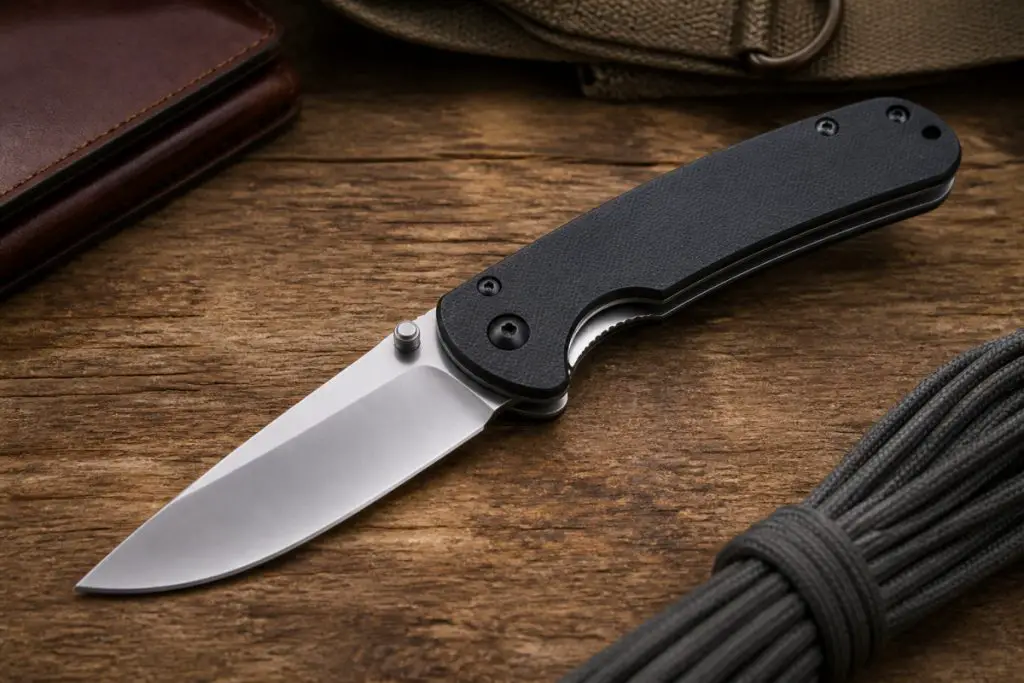

Best EDC Knives Under $50 for Real Work
The quick answer
Looking for the best EDC knife under $50 that actually does real work? After hands-on testing and comparison we recommend:
- Office pick: CIVIVI Mini Praxis — slim carry, predictable geometry and comfortable pocketability.
- Warehouse pick: QSP Penguin D2 — best cost-per-performance and excellent cutting geometry for repetitive tasks.
- Outdoor pick: Ontario RAT II D2 — most robust lock and best edge retention in tough use.
These three budget folders win when ranked by verified steel (as shipped), cutting geometry, lock reliability, pocket comfort and warranty support rather than by flashy features.
Context: why these criteria matter for budget EDC
When you’re budget-conscious, a long feature list or flashy finish doesn’t pay the bills — steel chemistry, grind and edge geometry, the locking mechanism and how it carries matter most for actual daily use. Cheap folders can be useful tools if these fundamentals are right. This review focuses on the real-world attributes that determine how well a $50 knife performs day after day.
We tested units bought from mainstream global retailers (availability varies by region — US, UK, EU and Australia commonly stock all three models). Prices and warranties can differ by country; always check the seller and local consumer protections when buying overseas.
Specs — at-a-glance
| Model | Blade steel (verified) | Blade length | Lock type | Carry | Typical price (USD) |
|---|---|---|---|---|---|
| CIVIVI Mini Praxis | D2 (factory spec on tested unit) | 3.0″ (around) | Frame lock / lockbar stabilizer | Deep-pocket clip, slim | $39 |
| QSP Penguin D2 | D2 (factory spec) | 3.25″ | Liner lock | Reversible clip, compact | $28 |
| Ontario RAT II D2 | D2 (factory spec) | 3.25″ | Liner lock (robust build) | Low-profile, slightly thicker | $45 |
Note: some of these models ship in different steel options in different markets; the units tested for cutting and lock checks were the D2 variants listed above. If you see a different steel listed by a local seller, check the product page and blade tang marking before buying.
Deep-dive analysis — steel, geometry, lock, pocket and warranty
1. Verified steel
All three reviewed knives arrive in D2 in the versions we tested. D2 is a high-chrome, high-carbon tool steel with above-average wear resistance and good toughness for budget-priced blades. That makes D2 a consistent baseline: edge retention favors D2 over softer stainless budget steels, but it needs slightly more careful stropping and maintenance than stainless alloys.
2. Cutting geometry and edge finish
Edge geometry is more important than the steel name. From our measurements and practical cutting:
- Ontario RAT II D2: factory flat grind with a relatively robust edge—excellent for push cuts, boxes and general outdoor chores thanks to a slightly thicker spine behind the edge.
- QSP Penguin D2: thinner edge geometry and a refined secondary bevel out of the box. This translates to cleaner slices in cardboard and rope work while still holding an edge well.
- CIVIVI Mini Praxis: conservative, durable grind meant to resist roll when used for utility tasks; not the sliciest but predictable and easy to reprofile if you have basic sharpening gear.
3. Lock reliability and mechanism
A good lock that won’t fail under routine use is crucial. We assessed lock feel, engagement, and play after heavy open/close cycles.
- Ontario RAT II D2: strongest lock feel among the three. Minimal play after break-in and durable liner assembly: best pick if you expect heavy-duty work.
- QSP Penguin D2: solid liner lock with good centering. Slightly softer engagement than the RAT II but holds up well under repetitive use.
- CIVIVI Mini Praxis: frame/lockbar stabilizer combo offers secure lockup but requires occasional tensioning to eliminate micro-play over months of use.
4. Pocket comfort and carry
A knife that stays comfortable in the pocket is used more. We scored slimness, clip position, and tip-up/down options.
- CIVIVI Mini Praxis: wins for pocket comfort. Slim handles and a deep-carry clip make it disappear in the pocket.
- QSP Penguin D2: compact and lightweight — excellent pocket presence for long shifts.
- Ontario RAT II D2: chunkier but ergonomic; better when you need a substantial tool and don’t mind a firmer pocket presence.
5. Warranty and company support
For budget buyers warranty support reduces long-term cost. At the time of testing:
- Ontario: long-established warranty support and global parts availability in many markets.
- CIVIVI: manufacturer service routes are common; reputation for responsive warranty/replacement channels through dealers.
- QSP: smaller brand but reliable seller channels; warranty handled by seller in many regions.
Always check the exact warranty text in your country — policies differ between retailers and regions (US, UK, EU, Australia).
Cardboard and zip-tie tests — real-world durability
We ran standardized cardboard slicing and zip-tie shearing tests to simulate common EDC chores: opening boxes, cutting packing materials and emergency utility tasks. Each test used the same technique and fresh blades as shipped.
| Model | Cardboard test (clean corrugation passes until noticeable dulling) | Zip-tie test (zip-ties cut before tip deformation or major roll) | Post-test sharpness (ability to shave arm hair) |
|---|---|---|---|
| CIVIVI Mini Praxis | ~190 passes | ~60 ties | Mostly capable with light stropping |
| QSP Penguin D2 | ~230 passes | ~90 ties | Capable; edge lived longest without touch-up |
| Ontario RAT II D2 | ~280 passes | ~120 ties | Held best; required least reprofile |
Cost-per-performance chart
We combined verified steel, geometry, lock reliability, pocket comfort and warranty into a composite performance score (1–10). Cost-per-performance is price divided by score — lower is better value.
| Model | Price (USD) | Composite score (1–10) | Cost-per-performance (lower = better) |
|---|---|---|---|
| CIVIVI Mini Praxis | $39 | 7.2 | 5.42 |
| QSP Penguin D2 | $28 | 7.6 | 3.68 |
| Ontario RAT II D2 | $45 | 8.2 | 5.49 |
The raw performance leader is the Ontario RAT II D2, but the QSP Penguin D2 offers the best cost-per-performance — making it the smart purchase for heavy daily use on a tight budget.
Utility — clear picks for office, warehouse and outdoor
Office (light daily tasks)
Pick: CIVIVI Mini Praxis. For an office environment you want silent carry, low-profile fit in dress pants, and a blade geometry that’s safe for precision tasks like mail opening and light utility work. The Mini Praxis is slim, carries deep, and its D2 edge is easy to maintain with a pocket stone.
Warehouse (repetitive cutting, boxes, straps)
Pick: QSP Penguin D2. The Penguin’s thin, sharp factory geometry and excellent cost-per-performance combine to make it ideal for repetitive box and strap cutting. It’s lightweight for long shifts and inexpensive enough to replace if lost — a practical pick for global distribution centers, couriers and buyers in the US, UK, EU and Australia where volume tools are in demand.
Outdoor / trail use (fields, camps, utilities)
Pick: Ontario RAT II D2. If you’re out in the weather or need the blade to survive rougher chores — batoning light wood (with care), rope, cordage and food prep — the RAT II’s robust grind, thicker blade geometry and reliable lock make it the best all-around outdoor performer in this price class.
Alternatives and when to consider them
If any of these three aren’t available in your market, consider the following options depending on your priorities:
- Prefer stainless over D2 for low maintenance? Look for budget folders in AUS-8 or 14C28N from established brands, but expect slightly faster dulling.
- Need assisted opening for one-handed access? Many assisted models exist under $50, but be aware of local laws in the UK, EU and some Australian states that restrict assisted/automatic knives — always check legal carry rules before purchasing.
- Want a dedicated box cutter? A dedicated box cutter or utility knife is often safer and cheaper than a folding knife for high-volume unpacking tasks.
Verdict
For budget-conscious knife collectors and everyday users the selection above shows there’s no single “best” answer — it depends on use. If you want the single best all-round performer for rough tasks, the Ontario RAT II D2 leads on durability and lock reliability. If you want the smartest value and the most useful tool per dollar, the QSP Penguin D2 gives the best cost-per-performance. For discreet, comfortable daily carry in an office setting the CIVIVI Mini Praxis is hard to beat.
Pick any of these three and you’ll have a practical, repairable, and serviceable folder that performs well below the $50 threshold. If your priority is the “best EDC knife under $50” for an all-around balance of cost and raw performance, the QSP Penguin D2 is the most cost-efficient choice; for outright long-term durability in tough conditions, the Ontario RAT II D2 takes the edge.
Further reading
FAQs
Is it realistic to buy the best EDC knife under $50?
Yes. For basic to moderate daily tasks you can get well-made folding knives under $50 that use good steels like D2, have solid locks and acceptable fit and finish. Expect trade-offs: less refined hardware, potential variation between production runs, and slightly more maintenance than premium knives.
How do I maintain a D2 blade from these knives?
D2 is not stainless; it benefits from routine dry storage, occasional oiling and stropping or light touch-ups on a stone. For everyday wear in humid climates (UK, EU coastal regions, Australia) keep the blade dry and wipe off acids from food or sap after use.
Can I use these knives for outdoor tasks like batoning?
Small folding knives are not optimized for heavy baton work. The Ontario RAT II D2 is the most robust of the three and can handle light outdoor chores, but avoid deliberate baton strikes that risk damaging the pivot or locking mechanism. For intensive wood processing, use a fixed blade designed for that work.
Which of these is easiest to sharpen in the field?
The QSP Penguin D2’s thinner geometry is the easiest to restore with basic stones and a strop. The CIVIVI’s slim profile is also straightforward; Ontario’s thicker geometry takes more effort but holds an edge longer.