
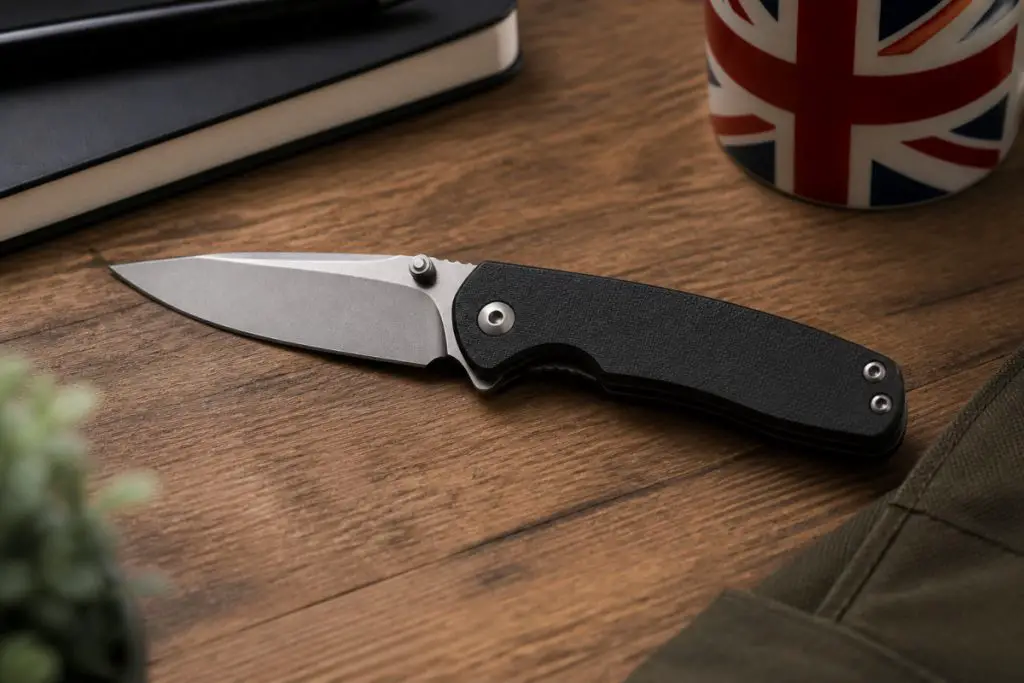

UK Knife Laws: What You Can Carry in 2026
Not legal advice — This article explains current guidance and common scenarios for everyday carry (EDC) knives in the United Kingdom. It is informational only. For definitive legal advice about your specific situation, consult a solicitor or the official government sources linked below.
The quick answer
In short: you can generally carry a non-locking folding pocketknife with a cutting edge no longer than 3 inches (about 76 mm) without a “good reason” under current UK rules, but many other designs are illegal to possess in public and some places remain completely off-limits. Whether a particular knife is legal to carry also depends on how it works (locking vs non-locking), where you are (schools, courts, stadiums, transport hubs), and why you have it. Always check the latest guidance on GOV.UK and the relevant Acts on legislation.gov.uk before carrying a blade in public.
Context
EDC enthusiasts need practical, up-to-date interpretations of UK knife laws because the difference between a compliant pocketknife and an illegal weapon can be a few millimetres or the presence of a locking mechanism. This guide focuses on everyday scenarios for non-locking folding knives, the practical meaning of the “3-inch cutting-edge” rule, what counts as a good reason, banned designs, and places where carrying any blade is prohibited.
For official, regularly updated government guidance see:
Buying and carrying knives on GOV.UK.
For the primary legislation texts consult:
Offensive Weapons Act 2019 (legislation.gov.uk)
and other Acts on legislation.gov.uk.
Specs
Key definitions and technical specs you need to understand when assessing a folding knife for legal carry in the UK:
- Cutting edge: the sharpened portion of the blade from the tip to where the sharpened edge meets the handle or stop. The 3-inch rule applies to the cutting edge length.
- Non-locking folding knife: a manually folding knife where the blade is held in the open position by friction or a backspring rather than a dedicated locking mechanism that prevents the blade from closing under pressure.
- Locking knife: has a mechanism (liner lock, frame lock, lockback, etc.) that secures the blade open. These are more likely to be considered offensive weapons in public without good reason.
- Banned designs: automatic (switchblade), gravity knives, flick knives, and disguised or extendable blades (e.g., belt-buckle knives) are prohibited.
- Good reason: a legally defensible explanation why you had the knife in public — examples include work, religious observance, or recreation like fishing (see GOV.UK guidance).
| Feature | Typical legal status (public without good reason) |
|---|---|
| Non-locking folding knife, cutting edge ≤ 3 inches | Usually permitted |
| Non-locking folding knife, cutting edge > 3 inches | May be illegal without good reason |
| Locking folding knife (any cutting edge length) | Riskier — likely illegal without good reason |
| Automatic/switchblade, gravity knife, disguised blade | Generally illegal to carry |
Deep-dive analysis
Below we build scenario-based guidance around typical EDC uses and examine how the 3-inch rule, good reason, banned designs and restricted places apply in practice.
How the 3-inch cutting-edge rule works (practical measurement)
The commonly quoted “3-inch rule” is a practical shorthand used in England and Wales for folding pocketknives: a non-locking folding knife with a cutting edge no longer than 3 inches (≈76 mm) is easier to justify as lawful for everyday carry. Note that cutting edge length—not overall blade length or spine length—is the relevant measurement. The cutting edge is the sharpened edge only.
Measurement diagram (textual)
---------------------------------------
Handle ||
Practical tips for measuring:
- Open the blade fully and lay it flat with the spine straight.
- Measure along the sharpened edge from the tip to the point where the cutting edge meets the handle or blade tang.
- Ignore decorative serrations that do not form part of the main cutting edge line; if in doubt, measure the full sharpened portion.
Non-locking folding knives: why they matter
Non-locking folding knives are treated more leniently because they are typically perceived as utility tools rather than fighting blades. A non-locking mechanism that can close under deliberate pressure is easier to present as a tool: the absence of a lock lowers the risk profile in the eyes of some enforcement officers and courts. That does not mean they are automatically legal; location and intent still matter.
Good reason: what courts consider
"Good reason" is a legal defence: you must show why you had the knife. Commonly accepted reasons include:
- Occupational requirement (e.g., chef, tradesperson) — ideally evidenced by ID or employer confirmation.
- Religious observance (e.g., Sikh kirpan) — potentially protected with qualifying conditions.
- Recreational use such as fishing or camping — the knife should match the activity (a camping knife rather than a long-bladed knife for the street).
- Transporting the knife securely (e.g., from home to work) — better to keep it sheathed and out of immediate reach.
Carrying a knife "for protection" is not a valid good reason. If an officer suspects you intended to use a blade offensively, mere possession can lead to arrest.
Banned designs and restricted mechanisms
The following types of knives are either banned or highly restricted in public under UK law:
- Automatic or switchblade knives (blade opens automatically with a button or spring).
- Gravity knives (opened by gravity or flicking motion).
- Flick knives and other knives designed to open rapidly with one hand.
- Disguised knives (e.g., walking sticks, belt-buckle knives).
Many locking knives are not strictly banned by design, but carrying one in public without good reason will typically be harder to justify. Where legislation has been tightened, enforcement has focused on intent and public safety rather than on single mechanical traits — but mechanics matter during stops and searches.
Restricted places — where you should never carry a knife
Certain places have explicit bans or policies that prohibit knives entirely, regardless of size or locking type. Examples include:
- Schools and further education institutions — knives are strictly prohibited on school premises.
- Airports, aircraft, certain train stations and other transport security zones — strict prohibitions/controls apply.
- Certain public events, sports stadiums and concert venues — event organisers and police often ban knives.
- Courts, prisons and other secure government facilities.
Even outside these locations, carrying a knife into a busy city centre, into protest zones, or into locations where a knife may alarm the public can increase the chance of being arrested.
Utility
This section gives scenario-based guidance for EDC fans deciding whether to carry a non-locking folding knife in 2026.
Scenario 1 — Urban commuter (daily commute, city centre, public transport)
Typical carry: compact non-locking folding knife with cutting edge ≤ 3 inches, slim profile, secured in pocket. Decision logic:
- Is the blade non-locking and cutting edge ≤ 3 inches? If yes, proceed to step 2.
- Are you carrying it for a practical reason (lunch opening, small repairs)? If yes, keep it concealed and accessible only when needed.
- Avoid carrying if your route includes secure transport hubs or large station concourses; store the knife in checked luggage or at home while using transport security zones.
Scenario 2 — Country walker or angler
Typical carry: a slightly larger utility knife for rope and food prep. Decision logic:
- If the blade is larger than 3 inches, ensure you have a clear recreational reason (e.g., fishing kit) and can demonstrate that reason if challenged.
- Transport the knife to and from the site in a bag; when not in active use, keep it sheathed to avoid appearing as though you are carrying it as a weapon.
Scenario 3 — Tradesperson or craftsman
Typical carry: job-specific knives or multi-tools. Decision logic:
- Carry evidence of work (ID, job sheet) where possible; employers’ confirmation helps if stopped.
- Prefer non-locking folding knives when entering public areas; lockable or larger tools can be carried in work vehicles and accessed on site.
Scenario 4 — Festival or concert
Most festivals and concerts ban knives entirely. Never assume a small non-locking pocketknife will be acceptable. Check the event's prohibited items list beforehand and leave knives at home.
Alternatives
If you want to stay safe, compliant and still prepared, consider these alternatives to carrying a blade in public:
- Keychain tools without sharpened blades (e.g., box-openers that are not classed as knives in all cases) — check local guidance.
- Small folding scissors (where permitted) or a compact multitool stored in a bag rather than on the person.
- Carry a dedicated work kit in your vehicle or backpack that contains larger blades stored securely and accessed only when necessary.
Verdict
For EDC fans in the United Kingdom in 2026 the safest, most defensible everyday carry is a small, non-locking folding pocketknife with a cutting edge no longer than 3 inches, carried only for practical reasons. Locking knives, automatic mechanisms, and disguised blades increase legal risk. The biggest factors in whether you can carry a knife without legal trouble are location and intended use; "for protection" is not a good reason. Always check GOV.UK guidance and legislation.gov.uk for updates before you travel or change your EDC setup.
Yes-or-no carry decision tree
Use this simple flow to help decide whether to carry a folding knife on a given outing.
- Do you need the knife for work or a legitimate activity today?
- No → Do not carry.
- Yes → Proceed to 2.
- Is the knife a non-locking folding knife with cutting edge ≤ 3 inches?
- Yes → Proceed to 3.
- No → Only carry if you have clear evidence of job-specific need and can transport it safely (best kept in a bag or vehicle).
- Will you enter any restricted place (school, stadium, security checkpoint) during this outing?
- Yes → Leave the knife secured off-person or do not carry.
- No → Carry concealed and use only for the task; be ready to explain the purpose.
Change log
- 2026-09-05 — Article published covering current interpretations for EDC in 2026 and updated links to GOV.UK and legislation.gov.uk.
- 2025-12-10 — Clarified measurement method for cutting edge and expanded scenarios section.
- 2024-06-01 — Initial draft focusing on non-locking folding knives and decision tools for commuters and outdoor users.
Further reading and internal resources
Explore our site for more EDC tips and product roundups:
- More articles and news (site sitemap)
- Product listings and EDC gear (site sitemap)
- Categories and guides (site sitemap)
FAQs
Can I carry a locking folding knife in public?
A locking folding knife is more likely to be considered an offensive weapon when carried without good reason. If you must carry one for work, keep documentation available and avoid carrying it into restricted areas. When in doubt, use a non-locking alternative.
Is a 3-inch blade allowance the same across the whole UK?
England and Wales commonly reference the 3-inch non-locking pocketknife guidance. Scotland and Northern Ireland have their own nuances in legislation and enforcement. Always consult the specific guidance for the country within the UK where you are carrying the knife — check GOV.UK and the devolved administration pages if travelling.
How should I transport a knife if I can’t carry it on my person?
Transport knives securely in a locked compartment, stored in luggage or a vehicle boot, or in a sheath within a bag. Keep the knife inaccessible during transit to avoid suspicion or accusation of intent to use it offensively.
Are multi-tools with small blades treated the same as pocketknives?
Multi-tools that include a small folding blade are often treated similar to non-locking pocketknives, but enforcement can vary. If the blade is locking or larger than 3 inches, the same cautions apply. Use non-blade tools where possible for public carry.
Last checked: 2026-09-05. Official guidance and legislation may change. Always verify with GOV.UK and legislation.gov.uk before relying on this article for decisions that could affect your legal status.