
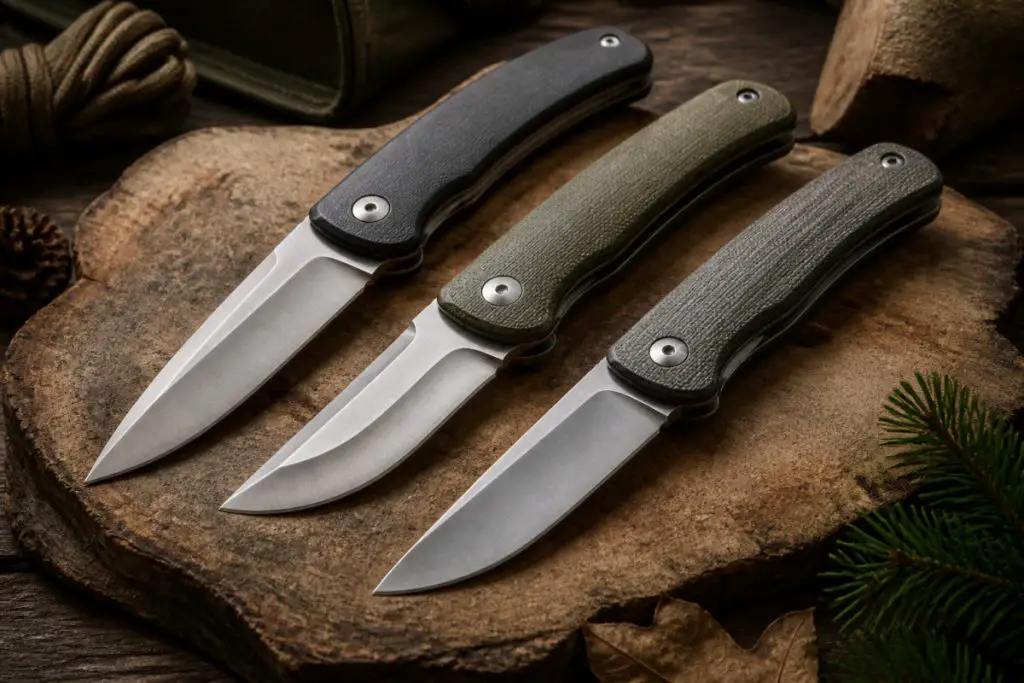

Scandi vs Convex vs Flat Grind for Bushcraft
The quick answer
For bushcraft tasks, there is no single “best” grind—each shines on different tasks. If you want clean, repeatable feather sticks and notches, a Scandi grind usually wins. For controlled splitting and heavy baton work a convex grind gives better resistance to pinching and rolls through wood. A flat grind is the most versatile compromise for food prep and general utility when paired with the right blade thickness. Read on for task-by-task testing, cross-section diagrams, sharpening steps, and a simple flowchart to choose the right grind for your next trip.
Context
The debate “Scandi vs convex vs flat grind” comes up every time someone chooses a fixed blade for bushcraft or chooses a new camp knife. Bushcraft tasks are repeatable and specific: feather sticks, notch cutting for traps or shelters, food prep, and controlled splitting. Grind geometry interacts with blade thickness, edge bevel angle, and steel type to produce very different outcomes. This guide focuses on geometry and thickness rather than steel chemistry, so practitioners from Scandinavia to the Pacific Northwest, Australia, the UK and beyond can apply the principles to local woods and conditions.
Specs
Here are the standard characteristics used for the tests below. All tests assume a similar 100 mm working edge on full-tang fixed blades of common bushcraft steels. Blade thicknesses were grouped as thin (2.5–3.0 mm at the spine near the handle), medium (3.5–4.5 mm), and thick (5.0+ mm).
| Grind | Typical bevel profile | Common edge angle (per side) | Typical strengths |
|---|---|---|---|
| Scandi | Single wide bevel to the edge, no secondary microbevel | 15°–20° (per side) | Very precise carving, easy to reprofile and maintain in the field |
| Convex | Curved belly to the edge (frowny profile), rounded cross-section | Varies — often 12°–20° effective behind edge due to roll | Strong edge that resists pinching and rolling; excellent for splitting |
| Flat | Flat plane from spine to edge (full-flat) or near-flat with a microbevel | 15°–25° (per side) depending on thickness | Versatile slicing and chopping when geometry is balanced |
Deep-dive analysis
Tests below compare the three grinds across four practical bushcraft tasks: feather sticks, notches, food prep, and controlled splitting. For each task I describe how the grind performs and how blade thickness changes the result.
Cross-section diagrams (simplified)
| Grind | Cross-section (side view) | Notes |
|---|---|---|
| Scandi |
/\\ /__\\ (single flat bevel) |
Flat primary bevel that ends at the edge; easy to pare wood and make thin shavings. |
| Convex |
/~~~~\\ /______\\ (curved belly to edge) |
Rounded profile behind edge distributes stress and resists pinching; better for batoning routines. |
| Flat |
/——\\ /________\\ (flat-to-edge plane) |
Plane from spine to edge offers balanced slicing; with a microbevel improves edge durability. |
Task-by-task findings
Each task below includes qualitative notes on how blade thickness affects performance.
Feather sticks
Scandi: Best. The wide single bevel bites predictably and fractures wood along the grain cleanly. Thin-to-medium spine (2.5–4 mm) makes fine, controlled shavings. Thick spines blunt the feel and require more force.
Convex: Good with skill. The rounded profile can still form feathers but requires a keen edge and more controlled slicing strokes. Thicker convex blades (4.5–6+ mm) are less precise but hold up during rough work.
Flat: Versatile but less forgiving. A thin flat (2.5–3.5 mm) with a low edge angle will pare feathers well; thicker flats lose the “knife as plane” feel and can tear rather than slice.
Notches (for shelters and traps)
Scandi: Excellent for precise, repeatable notches because of its planar bevel that resists catching on the cut. Again, thin to medium thickness works best for fine notches.
Convex: Very durable for deeper notches and when you need to remove larger sections without edge damage. Thicker convex blades excel here.
Flat: Reliable if kept sharp; deep notches are feasible but the flat can bind in tight cuts unless the edge is thin and sharp.
Food prep
Scandi: Great for peeling, slicing root vegetables, and fine carving but can struggle for push-cutting where a lower wedge angle slices better.
Convex: Excellent at slicing thicker items and for general camp cooking tasks because the rolled profile slices well and resists chatter. Medium thickness is ideal.
Flat: Most versatile for food prep. A thinner flat grind will give knife-like slicing performance similar to kitchen knives while a microbevel improves durability.
Controlled splitting
Scandi: Not ideal. The planar bevel can pinch when splitting larger pieces unless the blade is quite thick and the angle widened; it is better at controlled paring than at heavy splits.
Convex: Best. The rounded geometry pushes wood apart and resists pinching. Thick convex blades excel for baton work and limb splitting.
Flat: Good compromise. Thicker flats with a slight convex microbevel handle controlled splitting well, but full-flat thin blades will bind more easily.
Task scores (1–10)
Scores reflect combined performance across thin/medium/thick blade thickness groups, then averaged. Higher is better.
| Task | Scandi | Convex | Flat |
|---|---|---|---|
| Feather sticks | 9 | 7 | 7 |
| Notches | 9 | 8 | 7 |
| Food prep | 7 | 8 | 9 |
| Controlled splitting | 5 | 10 | 8 |
| Average | 7.5 | 8.25 | 7.75 |
Utility
How to apply these findings to real-world bushcraft gear choices. The grind choice should match your main tasks and local environment.
How blade thickness changes results (practical guidance)
- Thin blades (2.5–3.5 mm): Best for feathering, carving, and food prep. Use a Scandi or thin flat if those are your priorities. Avoid thin convexs for heavy splitting.
- Medium blades (3.5–4.5 mm): Great all-rounders. A medium convex or flat grind gives a balance of slicing and durability for general bushcraft.
- Thick blades (5.0+ mm): Built for baton work and splitting. Convex geometry at this thickness is often the most durable choice; Scandi at this thickness loses its carving advantage.
Sharpening steps (field and workshop)
Below are concise sharpening sequences tailored by grind. These avoid unnecessary rewriting of techniques; keep edges sharp, consistent and safe.
Scandi sharpening (field friendly)
- Secure blade and mark the bevel with a permanent marker to see wear.
- Use a flat diamond or coarse ceramic stone held flat to the bevel (not to the edge) and push evenly along the bevel to re-establish the planar face.
- Progress through grits (120 → 400 → 1000) until the bevel looks uniform. Keep the bevel angle consistent; Scandi is easy because the bevel is single-sided plane.
- Finish with a leather strop to remove burrs and polish.
Convex sharpening (best in workshop)
- Use a slack-belt, sanding wheel, or tapered ceramic rods to roll the profile. Small arcs are key — don’t change the overall edge geometry quickly.
- Work gradually across the rounded section from spine to edge in overlapping strokes, removing small amounts of metal to maintain the convex curve.
- Finish with progressively finer stones and a leather strop loaded with abrasive paste to polish the apex.
- Field touch-ups: use rounded ceramic rods or a tapered stone, maintaining the roll rather than creating a flat facet.
Flat grind sharpening
- Clamp the blade or use a guide to keep the flat angle consistent.
- Use a flat stone and push strokes from heel to tip maintaining the plane. Keep angles constant; consider a slight microbevel for durability.
- Finish with higher grit stones and strop. Microbevel (1–2° higher) helps flats resist rolling during heavy use.
Maintenance tips
- Carry a small stone or diamond rod for real-time touch-ups; Scandi is easiest to restore in the field.
- For convex blades, prioritize good workshop maintenance — field repairs should be conservative to avoid losing the roll.
- Monitor spine thickness; thinning a blade too much undermines splitting performance even if the edge cuts wonderfully.
Alternatives
If you can’t settle on one grind, consider these options:
- Hybrid grinds: A flat grind with a subtle convex microbevel blends slicing and durability. Many bushcraft knives ship like this by design.
- Replaceable systems: If you often change mission profiles, carry a thinner bushcraft folder or a small carving knife (Scandi) plus a heavier fixed blade (convex) for splitting.
- Local blade makers: Commission a knife with an edge geometry matched to your local woods. Local makers in regions with active bushcraft communities (Scandinavia, Pacific Northwest, UK, Australia) can craft blades tuned to common species like birch, cedar, oak or eucalyptus.
Verdict
When you weigh the practical testing, “Scandi vs convex vs flat grind” breaks down to mission-first selection:
- Choose Scandi if your primary activities are feather sticks, fine carving, and you value field sharpening simplicity (best with thin to medium spines).
- Choose Convex if you need maximum edge durability and controlled splitting or heavy baton work (best with medium to thick spines).
- Choose Flat if you want a true all-rounder for food prep and mixed tasks; pair a flat with a slight microbevel for durability across environments.
For many bushcrafters, a medium-thickness flat grind with a convex microbevel or a medium convex grind offers the best balance between practicality and robustness. If you live or practice bushcraft in different climatic zones—wet temperate forests like the UK or Pacific Northwest, or drier eucalyptus forests in Australia—adjust thickness and finishing accordingly (wider bevels for tougher woods).
Choose-your-grind flowchart
Follow this quick decision flow to pick a grind for your next trip:
- Is fine carving and feather stick production your #1 task?
- Yes → Scandi (thin/medium thickness).
- No → go to 2.
- Will you be splitting limbs and baton-heavy tasks often?
- Yes → Convex (medium/thick thickness).
- No → go to 3.
- Is camp cooking/food prep and general versatility most important?
- Yes → Flat with microbevel (medium thickness).
- No → Carry a pair: Scandi for carving + small convex or thicker flat for splitting.
Local and practical considerations (Global)
While this guide is global in scope, here are a few location-aware tips:
- In Scandinavia and northern Europe, local woods (birch, pine) respond well to Scandi-style carving; local makers often favor Scandi grinds.
- In the Pacific Northwest and the UK, mixed tasks benefit from medium-thickness flats with microbevels because of wet-to-dry seasonal wood density changes.
- In Australia, where hardwoods like eucalyptus are common, a thicker edge with convex shaping resists edge damage during splitting and batoning.
- Always check local national park or reserve rules about carrying fixed blades; many regions worldwide have different legal frameworks for blade length and carried tool type.
- Find local sharpening classes or bushcraft groups (city clubs, meetup groups, or guiding services) to practice grind-specific techniques in your home region.
Further reading
Learn more about knife geometry and maintaining your blade on KnifePulse sitemaps:
FAQs
Q: Which grind is easiest to sharpen in the field?
A: Scandi is the easiest to reprofile and sharpen in the field because it has a single flat bevel—simple stones and consistent strokes restore the bevel quickly.
Q: Can I convert a flat grind to convex or vice versa?
A: Yes, but conversions remove metal. Flattening a convex to a flat is doable with flattening stones or belts, while creating a true convex from a flat takes careful rolling on belts or sanding wheels and is usually best done by a skilled maker or in a workshop.
Q: Does steel type change which grind I should pick?
A: Steel affects edge retention and toughness, but grind geometry and thickness are still the primary factors for task performance. Tougher steels can allow thinner edges; very hard steels hold an edge longer but can be more brittle, so match steel and grind to expected tasks.
Q: For a single all-purpose bushcraft knife, what’s the safest pick?
A: A medium-thickness flat grind with a slight convex microbevel is the safest all-round choice for mixed bushcraft tasks, combining slicing ability, food prep performance, and reasonable splitting durability.
Q: How often should I reprofile a Scandi edge in the field?
A: Frequency depends on use. For daily heavy carving and feathering you might strop or touch-up every few days. A full reprofiling is typically done in the workshop when cutting performance noticeably drops.
If you want hands-on comparisons, bring knives of each grind to a local bushcraft course or meet-up and practice the four tasks above with different blade thicknesses. Practical experience guided by the principles here will make the difference between theory and long-term confidence in the field.